
27 July 2026
Built-in Dishwasher Guide for Portugal 2026 | Mudelar
Looking for the perfect built-in dishwasher in Portugal? My guide covers key features, sizes, and installation for your kitchen renovation. Get a free quote.
As a technical lead overseeing countless kitchen renovations across Portugal, I’ve seen first-hand how the right appliances can transform a space. A built-in dishwasher is more than a convenience; it's a key element of modern kitchen design. Unlike freestanding models, it integrates seamlessly behind a custom cabinet panel, creating a clean, uncluttered look that elevates your entire kitchen. Whether you’re in a new build in Braga or renovating a classic apartment in Lisbon, choosing the correct model is crucial. In this guide, I'll walk you through everything you need to know—from understanding different integration types and sizes to deciphering energy labels and ensuring a flawless installation. My goal is to empower you to make an informed choice.
Quick summary
- Integration Type is Key: Choose between fully integrated models, which are completely hidden for a minimalist look, and semi-integrated models, which have a visible control panel for easy access.
- Get the Size Right: Standard 60cm dishwashers are perfect for families, while 45cm slimline models are ideal for smaller households or compact kitchens in cities like Porto.
- Focus on Essential Features: Look for adjustable racking, a third cutlery tray, varied wash programmes (like Eco or Quick Wash), and smart connectivity for modern convenience.
- Check the Energy Label: The A-G EU energy label is your best guide to water and electricity consumption. An efficient model saves you money on utility bills over its lifespan.
- Mind the Noise Level: For open-plan living spaces, a quiet dishwasher (under 45 dB) is a necessity, not a luxury. This prevents disruption while you're relaxing or entertaining.
- Professional Installation is Non-Negotiable: Proper installation requires precise cabinetry work, secure plumbing connections, and safe electrical wiring to prevent leaks and ensure optimal performance.
Table of contents
- Understanding Built-in Dishwashers: Fully vs. Semi-Integrated
- Choosing the Right Size: Standard, Slimline, and Compact Models
- Essential Features for Modern Living in Portugal
- Deciphering Energy and Water Efficiency Labels
- The Installation Process: A Job for Professionals
- Top Brands and Reliability: What We See in the Field
- Recommended materials and options
- Quick comparison
- Common mistakes to avoid
- Pre-project checklist
- How Mudelar handles it
- Frequently asked questions (FAQ)
- Conclusion
Understanding Built-in Dishwashers: Fully vs. Semi-Integrated
The first decision you'll face is the type of integration. This choice directly impacts your kitchen’s final appearance and how you interact with the appliance daily. Both fully and semi-integrated dishwashers are designed to be installed flush within your cabinetry, but they differ in one crucial way: the visibility of the control panel.
Your choice depends entirely on your aesthetic preference and desire for convenience. In the high-end minimalist kitchens we often design in areas like Cascais and Oeiras, fully integrated models are the prevailing choice. However, for those who prioritise immediate feedback and control access, a semi-integrated model can be a very practical solution.
Fully Integrated Dishwashers: The Seamless Look
A fully integrated dishwasher is designed to be completely concealed behind a custom door panel that matches your kitchen cabinetry. The controls are located on the top edge of the door, completely hidden from view when the door is closed. This creates an uninterrupted, uniform look across your entire kitchen, as the dishwasher becomes indistinguishable from any other cabinet.
Many modern models project a light beam onto the floor (often called TimeLight or InfoLight by brands like Bosch and Siemens) to indicate when a cycle is running and when it's finished. This clever feature solves the only real drawback: not knowing the machine's status at a glance. They are the standard for achieving a truly high-end, bespoke kitchen feel.
Semi-Integrated Dishwashers: Function Meets Form
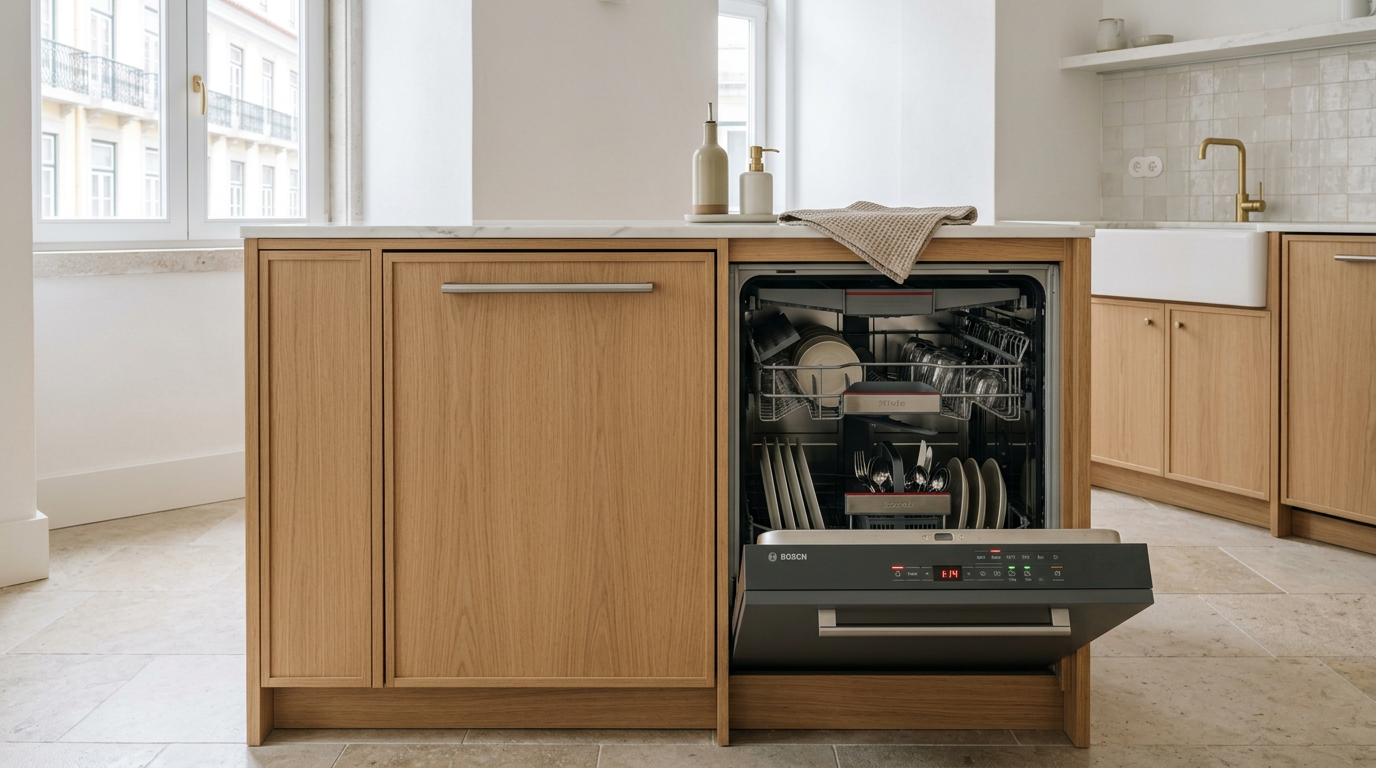
A semi-integrated dishwasher, also known as a partial-integrated model, also uses a custom front panel. However, the top section containing the control panel and display remains exposed. This breaks the seamless line of the cabinetry but offers the practical advantage of having the controls and cycle information visible at all times.
You can easily see the remaining time, select programmes, and start the machine without opening the door. This style is often chosen by clients who value function over pure form or are matching it with other appliances that also have visible control panels, creating a more technical, professional kitchen aesthetic. It’s a solid compromise between integration and accessibility.
Choosing the Right Size: Standard, Slimline, and Compact Models
After deciding on the integration type, the next critical factor is size. The right size depends on the physical space available in your kitchen layout and the needs of your household. In Portugal, the two dominant sizes are the 60cm standard model and the 45cm slimline version. Getting this wrong can lead to a kitchen that doesn't function well for your family or an installation that simply isn't possible.
Before you even start browsing, you must measure the width of the intended cabinet space. Remember to account for plumbing and electrical lines behind the unit. A standard cabinet is usually 60cm wide, but in older homes or custom layouts, this can vary. We always take precise measurements during our initial site visit to avoid any surprises.
The Standard 60cm Dishwasher
The 60cm wide dishwasher is the most common size, and for good reason. It’s the workhorse for most families, typically offering enough capacity for 12 to 16 place settings. If you have a family of three or more, cook frequently, or entertain guests, this is almost certainly the right choice for you. Its larger interior provides more flexibility for loading bulky items like pots, pans, and large plates.
In most of the kitchen renovations we undertake, from spacious villas in the Algarve to family homes in Setúbal, the 60cm model is the default. The sheer variety of features and efficiency ratings available in this size category is also much broader, giving you more options to choose from.
The Slimline 45cm Dishwasher
The slimline dishwasher, measuring 45cm in width, is the perfect solution for smaller kitchens, couples, or individuals. These models are incredibly popular in the apartments of central Lisbon and Porto, where space is at a premium. Despite their narrower profile, they are surprisingly spacious, usually accommodating 9 to 10 place settings—more than enough for daily use for one or two people.
A slimline model allows you to enjoy the convenience of a dishwasher without sacrificing an entire 60cm cabinet, which can be invaluable for storage in a compact kitchen. They offer most of the same advanced features as their larger counterparts, including quiet operation and various wash cycles, so you aren't compromising on performance.
Essential Features for Modern Living in Portugal
Beyond size and integration type, today’s dishwashers offer a host of features designed to make life easier, conserve resources, and deliver better cleaning results. When advising clients, I encourage them to look past the basic functions and consider which advanced features will genuinely improve their daily routine.
A quiet machine is a must for open-plan living, while flexible loading options can be a game-changer for families with varied dishware. As with any technology, it's easy to be swayed by features you'll never use. My advice is to focus on practical innovations that solve real-world problems.
Wash Cycles and Programmes
Standard dishwashers come with a few basic cycles: normal, intensive (for heavily soiled pots), and eco. However, more advanced models offer specialised programmes that are incredibly useful. An auto-sensing cycle uses sensors to detect how dirty the dishes are and automatically adjusts the water and temperature for optimal results. A quick wash (30-60 minutes) is perfect for lightly soiled dishes when you're in a hurry, and a hygiene cycle uses higher temperatures to sanitise items like baby bottles.
Interior Flexibility: Racks and Cutlery Trays
How you load the dishwasher is just as important as the wash cycle. Look for models with adjustable upper racks, which can be raised or lowered to accommodate tall glasses or large plates in the bottom rack. Fold-down tines provide flexibility for loading awkward items like bowls and pans. A big point of discussion is the cutlery tray versus the basket. A third-level cutlery tray at the very top frees up space in the lower rack and cleans each item more thoroughly. While a basket is easier to load and unload, the tray is superior for cleaning and space management.
Smart Technology and Connectivity
Many leading brands like Bosch, Siemens, and Miele now offer smart dishwashers with Wi-Fi connectivity. Using a smartphone app (like Bosch's Home Connect), you can start or monitor your dishwasher remotely, receive notifications when the cycle is finished, and even download new specialised wash programmes. The delayed start function is another fantastic feature, allowing you to set the dishwasher to run during off-peak electricity hours or to finish just as you get home.
Deciphering Energy and Water Efficiency Labels
In March 2021, the European Union introduced a new, stricter energy label for appliances, including dishwashers. The old A+++, A++, and A+ ratings were replaced with a simpler A to G scale. This change makes it easier to compare models, as an A-rated dishwasher under the new system is exceptionally efficient. Understanding this label is crucial for homeowners in Portugal, as it directly impacts long-term running costs and is an important part of energy performance considerations under regulations like DL 118/2013.
The label provides a wealth of information at a glance. It shows energy consumption in kilowatt-hours (kWh) per 100 cycles and water consumption in litres per cycle, both based on the 'Eco' programme. It also clearly displays the capacity in place settings, the duration of the Eco programme, and, critically, the noise level in decibels (dB).
Understanding the Energy Label
When comparing two models, don't just look at the headline A-G rating. Check the specific kWh/100 cycles figure. A difference of just a few kWh can add up over the 10-15 year lifespan of the appliance. The same goes for water consumption. A dishwasher that uses 9 litres per cycle is significantly more efficient than one that uses 12 litres, especially with rising utility costs. The Eco programme is the most efficient for normally soiled dishes, though it often has the longest duration.
The Impact of Noise Levels (dB)
The noise emission class, also rated from A to D, and the specific decibel (dB) value are vital, especially for open-plan kitchens common in new apartments in Amadora or Loures. A conversation is about 60 dB. A quiet library is around 40 dB. A modern, quiet dishwasher operates between 40 and 45 dB. Anything below 42 dB is considered virtually silent and is what I strongly recommend for open-concept living spaces to avoid disruptive noise while you're watching TV or relaxing in the evening.
The Installation Process: A Job for Professionals
Installing a built-in dishwasher is not a simple DIY task. Unlike a freestanding model that just needs to be pushed into place and connected, an integrated unit requires precision and expertise in carpentry, plumbing, and electrics. A poor installation can lead to leaks, damage to your cabinetry, poor wash performance, and even safety hazards. At Mudelar, this is a job we only entrust to our qualified and experienced technicians.
The process involves several critical steps that must be executed perfectly to achieve that flawless, seamless finish. It starts with ensuring the cabinetry is correct and ends with testing the machine thoroughly. This ensures your appliance not only looks great but also functions perfectly for years to come. Rushing this stage or cutting corners is a recipe for future headaches.
Cabinetry and Panelling
First, the designated cabinet space must be precise. The height, width, and depth must match the dishwasher's specifications perfectly. The most crucial part is fitting the custom door panel. This panel, often made from moisture-resistant MDF or a material that perfectly matches your kitchen, like from suppliers such as Egger or Kronospan, needs to be mounted securely to the dishwasher's front. We must also consider the plinth height; some installations require a dishwasher with a special sliding hinge to allow the door to open without hitting the plinth below. This is a small detail that can derail a project if overlooked.
Plumbing and Electrical Connections
The dishwasher needs a water inlet, a wastewater outlet (drain), and a dedicated, grounded electrical socket. The water inlet must have a shut-off valve for safety and easy maintenance. The drain hose must be looped correctly to a height specified by the manufacturer to create an anti-siphon trap, preventing dirty water from flowing back into the machine. The electrical connection should ideally be on a separate circuit and easily accessible, not directly behind the unit where it can’t be reached.
Levelling and Securing the Unit
Finally, the dishwasher must be perfectly level, both side-to-side and front-to-back. This is adjusted using the unit’s feet. A level dishwasher ensures that water distributes correctly inside and that the door seals properly, preventing leaks. Once level, the unit is physically secured to the adjacent cabinets or the countertop above (often a Silestone or Compac quartz top) using mounting brackets. This prevents the appliance from tipping forward when you pull out the racks.
Top Brands and Reliability: What We See in the Field
Request a free, no-commitment quote. We reply within 24 hours.
Request a quote →With years of experience installing appliances in homes across the country, from Porto to the Setúbal peninsula, we've developed a strong sense of which brands consistently deliver on their promises of quality and reliability. While personal preference plays a role, certain manufacturers have earned a reputation for superior engineering, durability, and excellent after-sales support in Portugal.
German brands like Miele, Bosch, and Siemens are consistently at the top of my recommendation list. Miele is renowned for its exceptional build quality and testing its products to last 20 years. Bosch and Siemens (part of the same BSH group) offer a fantastic balance of innovative features, reliability, and a wide range of models. Other brands like AEG also produce high-quality, dependable machines. Spanish brand Teka and Portuguese favourite Balay (also part of BSH) are also strong contenders, offering great value and solid performance with good service networks in Portugal.
Recommended materials and options
| Type | Features | When to choose |
|---|---|---|
| Fully Integrated | Completely hidden controls, custom door panel. | For a minimalist kitchen design where aesthetics are paramount. |
| Semi-Integrated | Visible control panel on a custom door front. | When you want quick, at-a-glance access to controls and cycle status. |
| Slimline (45cm) | Narrower width, available in fully or semi-integrated. | For smaller kitchens, apartments, or for couples and small families. |
| Smart Dishwasher | Wi-Fi connectivity, remote control via an app. | For tech-savvy homeowners who value convenience and remote management. |
| Quiet Model (<42dB) | Advanced insulation and motor design for low noise. | An absolute must-have for any open-plan kitchen and living area. |
Quick comparison
| Feature | Fully Integrated Dishwasher | Semi-Integrated Dishwasher | Freestanding Dishwasher |
|---|---|---|---|
| Appearance | Completely hidden by a matching cabinet panel. | Custom panel with a visible, exposed control strip. | Exposed unit with its own front, sides, and top. |
| Control Access | Hidden on the top edge of the door; requires opening. | Always accessible on the front of the appliance. | Always accessible on the front of the appliance. |
| Size Options | Standard (60cm) and Slimline (45cm). | Standard (60cm) and Slimline (45cm). | Standard (60cm) and Slimline (45cm), plus compact models. |
| Best For | Seamless, high-end, minimalist kitchen designs. | Users who prioritise function and quick control access. | Rental properties or kitchens not designed for integration. |
Common mistakes to avoid
- Measuring the Space Incorrectly. A few millimetres can make the difference between a perfect fit and an impossible installation. Always measure the height, width, and depth of the cabinet opening before purchasing.
- Ignoring the Plinth Height. If you have a tall kitchen plinth (kickboard), a standard hinge may not work. You will likely need a model with a 'sliding hinge' to allow the door to lift as it opens. Forgetting this is a common and frustrating mistake.
- Choosing a Noisy Model for an Open-Plan Home. The allure of a feature-rich but loud dishwasher quickly fades when its roar disrupts your evening. For open layouts, a noise level below 45 dB is essential.
- DIY Installation Without the Right Skills. Water and electricity are a dangerous combination. Incorrect plumbing can lead to major water damage. We always advise professional installation for safety and peace of mind.
- Forgetting to Order the Front Panel. The custom door panel is not included with the dishwasher. It must be ordered separately from your kitchen supplier to ensure a perfect match with your existing cabinetry.
- Neglecting Access to Water and Electrical Points. Ensure the water shut-off valve and electrical socket are accessible for future maintenance, not hidden directly behind the appliance.
- Not Levelling the Appliance. An unlevel dishwasher can lead to poor cleaning performance, drainage issues, and a door that doesn't seal correctly, potentially causing leaks.
Pre-project checklist
- Accurately measure the cabinet space (Height x Width x Depth).
- Confirm the location and accessibility of the water supply and drainage pipes.
- Verify there is a grounded electrical socket within reach of the appliance's cord.
- Decide between a fully integrated or semi-integrated model based on your kitchen's design.
- Choose a model with a noise level (dB) appropriate for your living situation (especially if open-plan).
- Source the correct size custom door panel from your kitchen cabinet supplier.
- Plan for professional installation coordination with your renovation team.
- Check if your plinth height requires a dishwasher with a sliding hinge.
- Select wash programmes and interior features that match your household's needs.
- Compare EU energy labels to choose an efficient model for long-term savings.
How Mudelar handles it
At Mudelar, integrating a new appliance like a built-in dishwasher is a core part of our turnkey renovation service. We take the complexity out of the process for you. During our initial on-site consultation, we take precise measurements and discuss your needs. We then help you select the perfect dishwasher from trusted brands, ensuring it has the right size, features, hinge type, and noise level for your home in Porto, Lisbon, or anywhere else we operate.
Our team manages the entire process: we source the appliance, ensure the custom panel from the cabinetmaker is a perfect match, and our certified plumbers and electricians handle the installation with meticulous care. This integrated approach ensures a flawless result, with all elements working in harmony. If you're ready to upgrade your kitchen, you can learn more about our services or feel free to request a free quote to get started. Our reputation is built on this kind of detailed, client-focused work, as you can see when you read about us.
Frequently asked questions (FAQ)
Do I need a special cabinet for a built-in dishwasher?
Yes, you need a standard-width cabinet space (usually 60cm or 45cm) without a back panel to accommodate the unit and its connections. An integrated dishwasher is designed to be installed under a continuous countertop and secured to the adjacent cabinets. It cannot be placed in a fully enclosed cabinet box.
How long does it take to install an integrated dishwasher?
For a professional, replacing an old integrated dishwasher with a new one in the same spot typically takes 1-2 hours. If it's a new installation requiring modifications to cabinetry, plumbing, or electrical wiring, the process can take longer, usually between 2-4 hours, depending on the complexity of the work.
What is the difference between an integrated and freestanding dishwasher?
An integrated (or built-in) dishwasher is installed inside your kitchen cabinetry and covered with a custom door panel to match. A freestanding dishwasher is a standalone unit with its own finished front and sides, which can be placed anywhere there are water and power connections. Integrated models offer a cleaner, more seamless look.
Are fully integrated dishwashers better?
Aesthetically, yes. A fully integrated model provides the most seamless and high-end look because it's completely hidden. Functionally, it's a matter of preference. Some people prefer the semi-integrated style as the controls are always visible. Both types offer the same cleaning performance and features from reputable brands.
How do you know when a fully integrated dishwasher has finished?
Since the controls are hidden, manufacturers have developed clever solutions. Most modern fully integrated dishwashers project a small beam of light onto the floor. A red light typically means the cycle is in progress, and a green light (or the light turning off) indicates it's finished. Some models even beep or send a notification to your phone.
Can any kitchen have a built-in dishwasher?
Almost any kitchen can be modified to accommodate one, but it's not always a straightforward swap. You need a dedicated space under the worktop, plus accessible water and electrical connections. In some older kitchens, this might require cutting into existing cabinets and extending plumbing, a job best left to renovation professionals like Mudelar.
What is a 'sliding hinge' on a dishwasher?
A sliding hinge (or vario-hinge) is a special mechanism that allows the custom door panel to slide upwards as you open the dishwasher. This is necessary in kitchens with long cabinet doors or low plinths (kickboards), as it prevents the bottom of the door from hitting the plinth. It’s an essential feature for many modern kitchen designs.
How do I choose the right size dishwasher?
Base your choice on your household needs and available space. A 60cm standard dishwasher is best for families of three or more. A 45cm slimline model is perfect for couples, individuals, or kitchens where space is a premium. Always measure your cabinet opening before you buy to ensure a perfect fit.
Conclusion
Selecting the right built-in dishwasher is a decision that balances aesthetics, functionality, and long-term efficiency. By focusing on the correct integration type, size for your household, essential features like quiet operation, and a professional installation process, you ensure this hardworking appliance enhances your kitchen for years to come. The goal is a seamless look backed by powerful, reliable performance. Don't let the technical details of plumbing, electrical work, and custom panelling overwhelm you. Let our expert team at Mudelar manage the entire process for a perfect, hassle-free result. To start planning your kitchen upgrade, please request a free quote today.
Ready to start your renovation?
Request a free, no-commitment quote. We reply within 24 hours.
Request a quoteLer em português: Máquinas de Lavar Loiça Encastráveis: Guia Completo 2026 | Mudelar