
15 August 2026
A Guide to Kitchen Recycling Solutions 2026 | Mudelar
Discover the best kitchen recycling solutions for your home in Portugal. Our guide covers integrated bins and waste management systems. Get a free quote.
As a technical lead at Mudelar, I’ve overseen countless kitchen renovations across Porto and the north. One element that has shifted from an afterthought to a centrepiece of design is waste management. A truly modern kitchen isn't just about beautiful countertops and efficient appliances; it’s about seamless workflows. That's why planning effective kitchen recycling solutions from day one is critical. Gone are the days of a single, overflowing bin under the sink. Today, homeowners in Portugal need a system that elegantly handles general waste, plastics, paper, glass, and organic matter. In this guide, I'll walk you through the options, from sophisticated pull-out systems to clever food waste disposal, ensuring your new kitchen is as functional as it is beautiful.
Quick summary
- Plan Ahead: The most effective kitchen recycling solutions are integrated during the design phase of your renovation, not added as an afterthought.
- Integrated is Best: Pull-out bin systems concealed within cabinets are the gold standard for saving floor space and maintaining a clean, uncluttered aesthetic.
- Match Your Needs: The ideal system's size and number of compartments depend on your household size and the specific recycling streams required by your local council in areas like Lisbon or Braga.
- Manage Organic Waste: Dedicated solutions for food scraps, such as ventilated countertop caddies or in-sink disposers, are essential for hygiene and odour control.
- Quality Hardware is Key: For longevity and ease of use, always insist on robust metal runners, preferably with a soft-close mechanism, from reputable brands.
- Strategic Placement: For maximum efficiency, position your primary waste and recycling unit near the main food preparation zone and the sink.
Table of contents
- Why Integrated Kitchen Recycling is Non-Negotiable Today
- Types of Integrated Kitchen Recycling Solutions
- Choosing the Right System: Capacity and Configuration
- A Closer Look at Materials and Mechanisms
- Tackling Food Waste: Compost Caddies and In-Sink Garburators
- The Installation Process: What to Expect
Why Integrated Kitchen Recycling is Non-Negotiable Today
In modern home design, functionality drives form. A kitchen's success is measured by its workflow, and managing waste is a huge part of that. We've moved far beyond the single freestanding pedal bin. An integrated approach to kitchen recycling solutions reflects a commitment to both environmental responsibility and superior home ergonomics. It acknowledges that sorting waste is a daily, multi-step process that deserves its own dedicated, well-designed station within the kitchen layout. This is no longer a luxury; it's a fundamental component of a well-planned space.
For residents in Portugal, this is especially true. The national recycling system, with its colour-coded *Ecopontos* (yellow for plastic and metal, blue for paper and card, green for glass), necessitates separation at the source. Having a built-in system with multiple compartments makes this daily habit effortless. Instead of juggling multiple bags or making constant trips outside, everything is sorted neatly within a single cabinet, ready for disposal. This elevates the user experience and keeps your kitchen organised and hygienic.
The 'Kitchen Triangle' Evolved: The Workflow Zone
The classic 'kitchen triangle' (sink, hob, refrigerator) is evolving into a more comprehensive 'workflow zone' concept. This modern approach considers all key tasks, including food prep, cooking, cleaning, and waste disposal. The ideal location for your primary recycling unit is within this zone, typically in the cabinet next to the sink. This allows you to easily scrape plates, dispose of vegetable peelings, and rinse containers for recycling in one smooth, efficient sequence. By planning this from the start, we at Mudelar ensure your movements are logical and minimal.
Meeting Local Council Requirements in Porto and Lisbon
While the national *Ecoponto* system is standard, specific collection services and requirements can vary between municipalities. In dense urban areas like Lisbon, Porto, or Setúbal, apartment living makes convenient in-home sorting even more vital. Some councils are also introducing separate collections for organic food waste. A flexible, multi-compartment system allows you to adapt to these requirements easily, ensuring you can participate fully in local recycling initiatives without cluttering your kitchen with an array of separate bins and bags.
Types of Integrated Kitchen Recycling Solutions
When we talk about integrated solutions, we mean systems designed to fit perfectly within your kitchen cabinetry. These hide the mess, control odours, and free up valuable floor space. The choice depends on your cabinet layout, available space, and personal preferences. As a hands-on technical lead, I primarily work with three effective types of systems during our renovation projects.
These systems are a core part of modern kitchen ergonomics. They are not just about hiding bins; they are about making a daily chore simpler and more efficient. A well-chosen integrated system transforms waste management from a messy inconvenience into a clean, streamlined part of your kitchen routine. It’s a detail that has a surprisingly large impact on how much you enjoy using your space.
Base Cabinet Pull-Out Bins: The Gold Standard
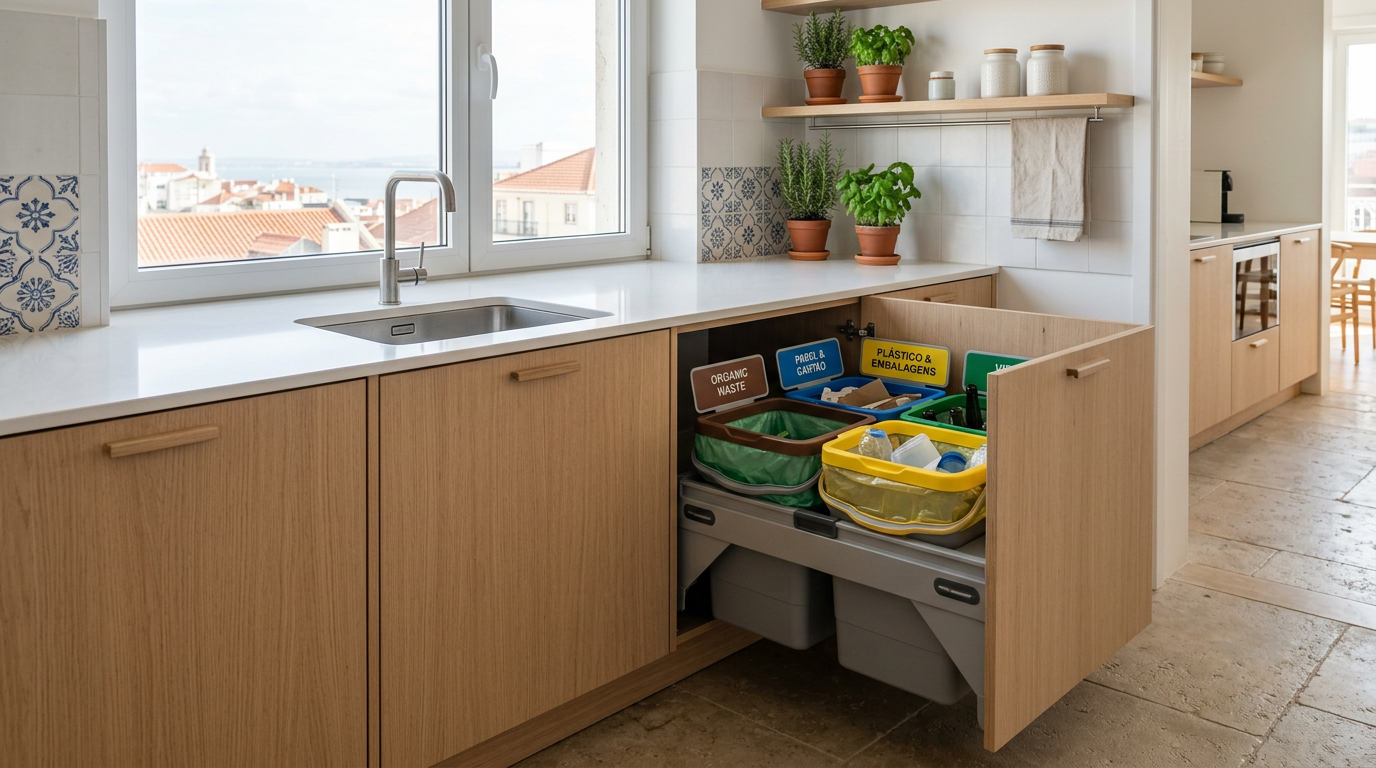
This is by far the most popular and, in my opinion, the most effective solution. The system is installed in a standard base cabinet (typically 40cm, 50cm, or 60cm wide). The bins are housed in a frame that slides out on runners when you open the cabinet door. Often, the frame is attached to the door itself, so a single pull reveals all compartments. These systems offer large capacities and can be configured with two, three, or four bins, making them perfect for comprehensive sorting.
Under-Sink Systems: Maximising Awkward Space
The cabinet under the sink is notoriously difficult to organise due to plumbing. However, specialised kitchen recycling solutions are designed to fit around the sink trap and pipes. These are often smaller in capacity but are brilliant for utilising otherwise wasted space. They typically consist of a sliding frame holding two or three smaller bins, ideal for general waste and food scraps, located right where you do most of your cleaning and prep work.
Drawer-Based Systems
For those who prefer the look of deep drawers, a recycling system can be integrated within one. This involves using a standard deep drawer box from a manufacturer like Egger or Kronospan and fitting it with custom-sized bin inserts. This creates a very clean, uniform look from the outside, as the bin drawer will match your other pan drawers perfectly. The key here is to use high-quality, heavy-duty drawer runners that can handle the significant weight of full bins.
Choosing the Right System: Capacity and Configuration
Selecting the right kitchen recycling solution isn't just about picking a type; it's about matching the system's capacity and layout to your family's needs and local recycling rules. A system that's too small will be a constant source of frustration, requiring frequent emptying. Conversely, an oversized system might take up valuable cabinet space that could be used for storage. The goal is to find the perfect balance for your household.
This planning stage is something we take very seriously at Mudelar. During our initial design consultations in homes across the country, from Aveiro to Braga, we discuss waste habits. How often do you cook? How many people are in the household? What are your local council's sorting requirements? Answering these questions allows us to recommend a system that you won’t have to think about once it's installed—it will just work.
Calculating Litre Capacity for Your Household
A good starting point is to consider your current waste output. As a general rule of thumb:
- 1-2 people: A total capacity of 30-40 litres is often sufficient.
- 3-4 people: Aim for a total capacity of 50-70 litres.
- 5+ people: Look for systems with 80 litres or more, potentially splitting waste between two cabinets.
Remember, this is total capacity. It will be divided among the different compartments. The general waste bin is usually the largest, followed by the bin for plastics and metals.
Two, Three, or Four Compartments?
For Portugal, a minimum of three compartments is highly recommended to align with the *Ecoponto* system: one for general waste, one for *Embalagens* (plastics/metals), and one for paper/card. A fourth, smaller bin is ideal for organic food waste or glass. Some larger systems offer a main bin of around 35 litres, two 17-litre bins, and perhaps a small 8-litre caddy with a lid for food scraps. This modular approach provides excellent flexibility.
A Closer Look at Materials and Mechanisms
The longevity and usability of your integrated bin system depend almost entirely on the quality of its components. This is an area where cutting corners is a mistake. The system will be used multiple times a day and must withstand the considerable weight of waste. I always advise clients to prioritise robust materials and proven mechanisms over saving a small amount of money on an inferior product. It’s the difference between a system that lasts two years and one that lasts for the lifetime of the kitchen.
We specify hardware from trusted brands known for their engineering, such as Blum or Hafele. The smooth, silent operation of a soft-close runner makes a world of difference in the daily experience of using your kitchen. Similarly, the bins themselves should be made from high-grade, easy-to-clean plastic that won't absorb odours or crack under pressure. These details are hallmarks of a quality renovation.
The Importance of High-Quality Runners
The runners are the backbone of any pull-out system. They must be full-extension, meaning the bins slide completely out of the cabinet for easy access. They also need to have a high weight rating, typically at least 40kg. Most importantly, I strongly recommend soft-close mechanisms. This prevents the unit from slamming shut, reducing noise and wear and tear on the cabinet, door, and the system itself. It’s a small detail that adds a touch of luxury and refinement.
Bin Materials: Durability and Hygiene
The bins themselves are typically made from high-quality ABS or polypropylene plastic. These materials are durable, resistant to cracking, and have a smooth surface that is easy to wipe clean. Look for systems where the bins can be easily lifted out of the frame for emptying and more thorough washing. Some systems also include lids for one or more compartments, which is essential for controlling odours from organic or general waste.
Tackling Food Waste: Compost Caddies and In-Sink Garburators
Managing organic waste is a critical part of a hygienic kitchen waste strategy. Food scraps are the primary source of odours and can attract pests. Having a dedicated, convenient solution is essential. In Portugal, with its culture of fresh cooking, dealing with vegetable peelings, fruit cores, and other organic matter is a daily task. A proper system makes this process clean and simple.
There are two main approaches to handling this type of waste within a modern kitchen design. The choice often comes down to personal preference, local regulations, and the extent of the renovation. Both options are a significant upgrade from a plastic bag hanging off a cabinet handle or an open container on the worktop.
Integrated vs. Countertop Compost Bins
The simplest solution is a small compost caddy. Many integrated kitchen recycling solutions include a small (3-8 litre) bin with a lid for this purpose. These are great because they are hidden away but still part of the central system. Alternatively, a stylish freestanding countertop caddy can be a good option. Look for models with a ventilated lid and a charcoal filter to control odours. They can be easily carried out to a larger compost bin if you have a garden.
Are Food Waste Disposers a Good Idea in Portugal?
In-sink food waste disposers (also known as garburators) are an option for ultimate convenience. These units are fitted to the drain of your kitchen sink and shred food scraps into fine particles that are flushed away into the sewage system. While common in North America, they are less prevalent in Portugal and their installation can be subject to local water authority regulations and the state of the building's plumbing. It's a fantastic solution for eliminating food waste from your bins entirely, but it requires professional assessment and installation, which is something we always verify before proceeding.
The Installation Process: What to Expect
As a technical lead, ensuring the perfect installation of every component is my responsibility. An integrated bin system might look simple, but a precise fit is crucial for smooth, long-term operation. A poorly installed unit can sag, catch on the cabinet, or put undue stress on the door hinges. This is a job for a skilled carpenter or kitchen fitter, not a last-minute DIY task.
Our process at Mudelar is meticulous. We don't just fit the system; we ensure it's perfectly calibrated to the specific cabinet and door. This involves careful measurement, precise assembly, and thorough testing to guarantee it glides effortlessly and quietly for years to come. It’s this attention to detail that defines a professional turnkey renovation.
Pre-Installation Cabinet Checks
Before we even order the unit, we take precise internal measurements of the designated cabinet: width, height, and depth. We also account for any obstructions like hinges or service pipes. We check that the cabinet carcass is structurally sound and perfectly square. For door-mounted systems, we also assess the quality and strength of the door hinges, upgrading them if necessary to handle the added weight and leverage.
Door-Mounted vs. Floor-Mounted Systems
There are two primary ways to install a pull-out system. A floor-mounted (or bottom-mounted) system has a frame that is fixed only to the base of the cabinet. You open the cabinet door first, then pull out the bin unit separately. A door-mounted system attaches the frame directly to the door, so the bins slide out in one motion as you open it. The latter is more ergonomic and is the preferred choice for most new kitchens we build in areas like Cascais and Sintra. However, it requires a sturdy door and robust hinges.
Recommended materials and options
Request a free, no-commitment quote. We reply within 24 hours.
Request a quote →| Type | Features | When to choose |
|---|---|---|
| Pull-Out Base Cabinet System | 2-4 compartments, soft-close runners, door-mounted frame. | For new kitchens or major renovations; provides the best ergonomics and capacity. |
| Under-Sink Drawer System | Custom inserts for existing drawers, designed to fit around plumbing. | When retrofitting or dealing with limited space directly under the sink bowl. |
| Freestanding Multi-Compartment Bin | Mobile, no installation needed, available in various styles and finishes. | For renters, smaller budgets, or when integrated solutions are not feasible. |
| Countertop Compost Caddy | Small (3-5L), often with charcoal filter, portable, hygienic design. | For easy collection and transfer of daily food scraps to a larger compost area. |
| In-Sink Food Waste Disposer | Grinds food waste into fine particles for flushing through plumbing. | For households wanting ultimate convenience in food waste disposal (check local regulations first). |
Quick comparison
| Feature | Integrated Pull-Out Bins | Freestanding Bins |
|---|---|---|
| Aesthetics | Completely hidden inside cabinetry for a seamless, uncluttered kitchen look. | Visible in the kitchen, can clash with decor and interrupt clean lines. |
| Space Efficiency | Utilises existing cabinet space, freeing up valuable floor area. | Occupies floor space that could otherwise be used for circulation. |
| Ergonomics | Easy, one-pull access, often at a comfortable height without bending. | Typically requires bending down; lids can be manual or foot-pedal operated. |
| Capacity | Generally offers larger total capacity (30-80L+) within a compact footprint. | Varies widely, but larger capacity models can be very bulky and intrusive. |
| Installation | Requires professional installation for correct alignment and function. | No installation required; simply place it where you want it. |
Common mistakes to avoid
- Underestimating Capacity. Choosing a bin system that is too small for your household's needs is a common pitfall. This results in constantly overflowing bins and frequent trips to the main rubbish area, defeating the purpose of the system's convenience.
- Ignoring Kitchen Workflow. Placing the bin system in an inconvenient location, far from the sink and food preparation area. The best spot is right in the 'action zone' to minimise drips and steps.
- Forgetting about Plumbing. When planning an under-sink unit, failing to accurately measure and account for the sink trap, water filter, and supply lines. This leads to ordering a system that simply won't fit.
- Choosing Flimsy Hardware. Opting for cheaper systems with low-quality plastic parts or weak runners. These will inevitably sag, jam, or break under the weight of full bins, requiring a costly replacement.
- Not Measuring Correctly. Relying on the cabinet's external width (e.g., a "60cm cabinet") instead of the precise internal width, depth, and height. Every millimetre counts for a perfect fit.
- Overlooking Lid Systems. Not specifying lids, especially for the organic and general waste compartments. An effective lid is crucial for containing odours and maintaining kitchen hygiene.
- Ignoring Door Hinge Strength. For door-mounted systems, failing to check if the existing cabinet door hinges are strong enough to support the added weight and leverage of the bin unit. This can cause the door to drop and misalign over time.
Pre-project checklist
- Measure the internal width, depth, and height of your target cabinet precisely.
- Confirm your local council's recycling categories (e.g., plastics/metal, paper, glass, organic, general).
- Estimate your family's weekly waste volume to determine the required total litre capacity.
- Decide between a more ergonomic door-mounted system or a simpler floor-mounted one.
- If planning an under-sink unit, map out the exact location and dimensions of all plumbing.
- Insist on a system with robust, full-extension, and soft-close runners for durability.
- Select the number and size of compartments that best matches your sorting needs.
- Verify if your cabinet door and hinges can adequately support a door-mounted system's weight.
- Check for any internal obstructions like electrical sockets or water pipes.
How Mudelar handles it
At Mudelar, we believe that a high-performance kitchen is a system where every part works in harmony. That's why we integrate kitchen recycling solutions into our design process from the very first conversation. We don't see it as an accessory; we see it as essential kitchen infrastructure. We help you select the ideal system based on your space in Porto, Lisbon or elsewhere, your family's needs, and your budget, sourcing high-quality units from trusted European manufacturers.
Our skilled carpenters then ensure a flawless installation, perfectly aligning the system within the cabinetry for a smooth and silent operation that will stand the test of time. It's this comprehensive approach that defines our turnkey service. We handle every detail, so you can simply enjoy a cleaner, more organised, and more efficient kitchen. To start planning your perfect space, request a free quote and we can discuss our services in detail. You can also learn more about us and our philosophy.
Frequently asked questions (FAQ)
How many recycling bins do I need in my kitchen in Portugal?
For most households in Portugal, a system with three or four compartments is ideal. This allows you to separate waste according to the standard *Ecoponto* colours: yellow (plastic/metal), blue (paper/card), and green (glass), plus a bin for general unsorted waste. A fourth, smaller compartment for organic food scraps is also highly recommended for hygiene and odour control.
What is the best location for a recycling bin in the kitchen?
The most ergonomic location is in a base cabinet next to the sink. This places the bins within the primary 'workflow zone' for food preparation and cleaning. It allows you to easily scrape leftovers from plates, rinse containers for recycling, and dispose of vegetable peelings in one efficient motion without dripping water or food across the floor.
Can I add an integrated bin system to my existing kitchen?
Yes, it is often possible to retrofit an integrated bin system into an existing kitchen, a process we frequently manage. It requires careful measurement of your current cabinets and potentially modifying a shelf. The key is to find a system with dimensions that match your available internal cabinet space. A professional fitter can ensure a seamless installation.
What size kitchen cabinet do I need for a pull-out bin system?
Integrated bin systems are designed to fit standard cabinet widths, most commonly 400mm, 450mm, 500mm, and 600mm. A 600mm cabinet will offer the largest capacity and the most flexibility in terms of the number and size of compartments. It's crucial to measure the internal width, not the external, to ensure you order the correct model.
How do I keep my integrated recycling bins from smelling?
Firstly, choose a system with well-fitting lids, especially for the organic and general waste sections. Secondly, empty the organic waste bin frequently, every 1-2 days. Finally, ensure the plastic bins are made from high-grade, non-porous material and wash them regularly with soap and water. A sprinkle of bicarbonate of soda in the bottom can also help absorb odours.
Is a food waste disposer (garburator) allowed in Portugal?
Generally, yes, food waste disposers are allowed, but their suitability can depend on the specific regulations of the local water authority and the condition of your building's plumbing, especially in older properties. It's essential to have a professional assessment before installation to ensure compatibility and compliance. They are a great convenience but require proper verification.
What's the difference between door-mounted and bottom-mounted bins?
A door-mounted system is physically attached to the cabinet door, so the bins slide out automatically when you open it. A bottom-mounted (or floor-mounted) system is fixed only to the cabinet floor; you open the door first, then manually pull out the bin unit. The door-mounted option is more ergonomic and feels more integrated, making it the preferred choice for new kitchens.
How long does it take to install an integrated bin system?
For a skilled professional, installing a standard pull-out bin system is a relatively quick job. Once the cabinet is prepared, the assembly and installation of the frame and bins typically take between 1 to 2 hours. This includes time for precise alignment and testing to ensure the mechanism operates smoothly and the door closes perfectly.
Conclusion
Ultimately, incorporating smart kitchen recycling solutions into your renovation is an investment in your home's daily function and your peace of mind. A well-designed, integrated system eliminates clutter, contains odours, and makes environmental responsibility an effortless part of your routine. It transforms a messy chore into a clean, simple, and hidden process. At Mudelar, we believe these details are what elevate a good kitchen to a great one. If you're ready to create a kitchen in Porto, Lisbon, or anywhere in Portugal that is as practical as it is beautiful, our team is here to help you plan every detail. To discuss the best waste management strategy for your new space, please request a free quote today.
Ready to start your renovation?
Request a free, no-commitment quote. We reply within 24 hours.
Request a quoteLer em português: Gestão de Resíduos na Cozinha: Guia Essencial 2026 | Mudelar