
22 July 2026
Kitchen Air Extraction for Open-Plan Homes 2026 | Mudelar
Choosing the right kitchen air extraction for your open-plan home is crucial. Our guide covers downdraft vs. ceiling extractors and more. Get a free quote!
As a project manager at Mudelar, I’ve overseen countless kitchen renovations across Lisbon and the surrounding areas. One of the biggest challenges in modern, open-plan homes is managing cooking fumes. Without the right kitchen air extraction system, steam, grease, and odours from your wonderful Portuguese cooking can quickly travel throughout your living space, settling on fabrics and surfaces. This isn't just about smells; it’s about protecting your home and maintaining good air quality. In this guide, I’ll walk you through everything you need to know, from choosing the right type of extractor—be it a sleek downdraft system or a powerful ceiling unit—to understanding the technical details of installation. My goal is to give you the confidence to make the best choice for your open-concept home.
Quick summary
- Ducted is superior: Whenever possible, a ducted system that expels air outside is more effective at removing humidity and odours than a recirculating one.
- Calculate the power: The extraction rate (m³/h) must match your kitchen's volume to be effective. Don't guess; a simple formula ensures you get it right.
- Modern solutions exist: Downdraft systems integrated into the hob and flush-fit ceiling extractors offer powerful, discreet ventilation perfect for kitchen islands.
- Ducting matters most: The performance of your extractor is heavily dependent on the quality of the ducting. Short, wide, and straight routes are best.
- Noise is a key factor: In an open-plan living area, a noisy extractor can be disruptive. Pay close attention to the decibel (dB) ratings.
- Design integration is key: Your extractor should complement your kitchen's aesthetics, whether it's a statement piece or completely hidden.
- Maintenance is mandatory: Regularly cleaning grease filters and replacing charcoal filters (in recirculating models) is essential for performance and safety.
Table of contents
- Why effective kitchen air extraction is non-negotiable in open-plan spaces
- Ducted vs. recirculating: The fundamental choice
- Types of extractor hoods for open-plan kitchens
- Calculating the right extraction power (m³/h)
- Ducting done right: A technical deep dive
- Noise levels, lighting, and smart features
- Recommended materials and options
- Quick comparison
- Common mistakes to avoid
- Pre-project checklist
- How Mudelar handles it
- Frequently asked questions (FAQ)
- Conclusion
Why effective kitchen air extraction is non-negotiable in open-plan spaces
Open-plan living is incredibly popular in new builds and renovations from Porto to the Algarve, celebrated for its social and spacious feel. However, combining your kitchen, dining, and living areas into one large room creates a unique set of functional challenges. The single biggest issue I encounter on projects is inadequate ventilation. Without walls to contain them, cooking by-products—steam, grease particles (aerosolised fat), and strong odours from frying fish or grilling meat—have free reign to spread throughout your entire home. This can lead to lingering smells, sticky films on furniture and electronics, and increased humidity levels that can contribute to dampness and mould over time, particularly in Portugal's coastal climates.
A powerful and correctly installed kitchen air extraction system is not a luxury in these spaces; it's a necessity. It works to capture these contaminants directly at the source—your hob—before they can escape. This protects your soft furnishings like sofas and curtains from absorbing odours, prevents a layer of grease from building up on your walls and surfaces, and helps control the overall humidity. Think of it as an essential appliance for maintaining a clean, healthy, and pleasant living environment. In many of our renovation projects in older apartment buildings in Lisbon, installing a proper system is a top priority for our clients.
Ducted vs. recirculating: The fundamental choice
When you choose an extractor, your first and most critical decision is whether it will be ducted or recirculating. This choice impacts performance, installation complexity, and long-term maintenance. A ducted system uses a pipe (the duct) to physically transport the captured air from your kitchen to the outside of your property. This is by far the most effective method, as it permanently removes steam, odours, and grease particles from your home. It’s the gold standard for kitchen air extraction and is what we at Mudelar always recommend if the building's structure allows.
On the other hand, a recirculating system does not expel air outside. Instead, it sucks the air through a series of filters. A grease filter captures fat particles, and then a charcoal (or carbon) filter absorbs odours. The 'cleaned' air is then released back into the kitchen. While these systems have improved significantly, they cannot remove moisture or heat. Recirculating is a practical solution when ducting to an external wall is impossible—a common scenario in apartments in central Setúbal or historic buildings where modifying the facade is restricted. It's important to remember that the charcoal filters need regular replacement (typically every 3-6 months) to remain effective.
Types of extractor hoods for open-plan kitchens
With the fundamental choice made, you can focus on the type of extractor that best suits your kitchen layout, design aesthetic, and cooking style. The market offers a fantastic range of solutions, moving far beyond the traditional wall-mounted hood.
Downdraft and hob extractors
These are the cutting edge of kitchen ventilation and are incredibly popular in high-end, minimalist open-plan kitchens. Brands like BORA and Elica have perfected hobs with a powerful extractor built directly into the centre or alongside the cooking zones. A downdraft extractor works by capturing steam and fumes right at the pot's edge, pulling them downwards before they have a chance to rise and spread. This is exceptionally effective and allows for complete design freedom, making them the perfect solution for a kitchen island where you want to avoid a bulky hood hanging from the ceiling.
Ceiling-mounted (flush) extractors
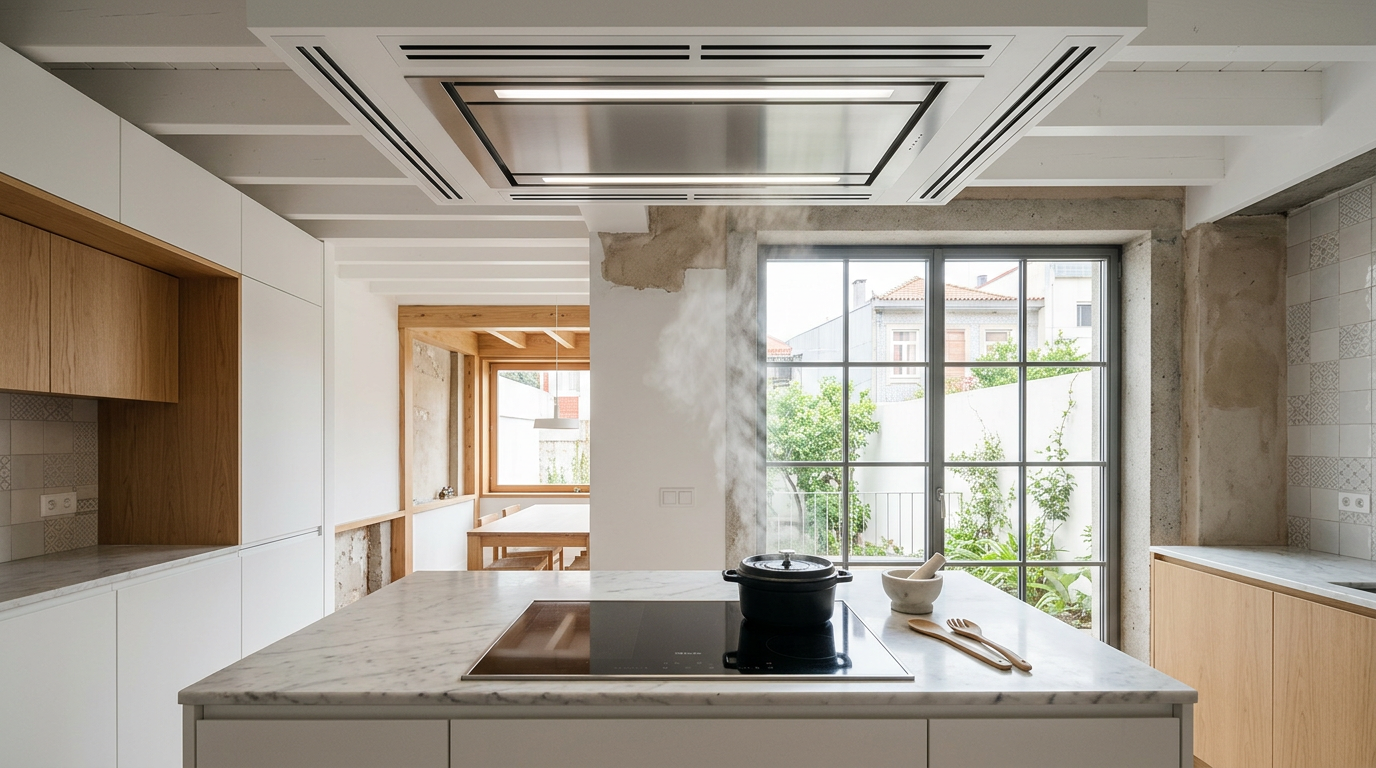
For a discreet yet powerful option, a ceiling-mounted extractor is an excellent choice. These units are installed flush with your ceiling, or into a lowered plasterboard section (a bulkhead), directly above the hob. They are operated by remote control and offer a wide extraction area, making them very effective. Because they are out of the line of sight, they help maintain that open, spacious feeling. Installation is more involved, as it requires planning the ducting route through the ceiling void and ensuring the structure can support the unit's weight. We often specify models from Falmec or Siemens for projects in areas like Cascais and Oeiras.
Island hoods (statement pieces)
If you want your extractor to be a design feature, a dedicated island hood is the way to go. These are suspended from the ceiling over your kitchen island and come in a vast array of shapes, materials, and sizes, from classic stainless steel cylinders to dramatic, sculptural designs that double as light fittings. While they can be very effective, it's crucial to choose a model with sufficient power and to install it at the correct height (typically 65-75cm above the hob) to ensure it functions well without being a visual or physical obstruction. They make a strong visual statement in a large open-plan space.
Wall-mounted hoods and hidden extractors
If your hob is positioned against a wall, your options are more traditional but no less effective. A classic wall-mounted hood can be a simple, functional 'T' shape or a more decorative angled design. For those who prefer a completely seamless look, an integrated canopy hood is the answer. These are built directly into the cabinet above the hob. When the unit is off, it's completely hidden from view behind a cabinet door. This is a clever way to conceal the functionality of a kitchen air extraction system while maximising a clean, uninterrupted line of cabinetry.
Calculating the right extraction power (m³/h)
Choosing an extractor that is too weak for your space is one of the most common and costly mistakes. In an open-plan room, you need an extractor with a high enough extraction rate—measured in cubic metres per hour (m³/h)—to effectively clear the air. There's a simple formula we use to determine the minimum power required:
Kitchen Volume (in m³) x Air Changes per Hour = Required Extraction Rate (in m³/h)
- Calculate the room's volume: Measure the length, width, and height of your open-plan area in metres and multiply them. For example, a room that is 8m long, 5m wide, and 2.5m high has a volume of 100 m³ (8 x 5 x 2.5).
- Determine air changes: For a kitchen, the air should be fully replaced between 10 and 12 times per hour. We always use 12 for open-plan spaces to be safe.
- Find the required rate: Multiply the volume by the air changes. In our example: 100 m³ x 12 = 1200 m³/h.
This means for that specific open-plan space, you should look for an extractor with a maximum (or 'boost') extraction rate of at least 1200 m³/h. Always check the technical specifications for this number. An underpowered unit will struggle to cope, meaning odours and steam will escape into your living area regardless of how good the extractor looks.
Ducting done right: A technical deep dive
The most powerful extractor in the world will perform poorly if the ducting is not installed correctly. This is an area where I see many DIY and less-experienced installations fail. The goal is to create the smoothest, most direct path for the air to travel from the hood to the outside. Any obstruction, sharp bend, or reduction in diameter will increase air resistance and noise, and dramatically reduce the extractor's efficiency.
For best performance, always use rigid, smooth-walled ducting with a diameter of at least 150mm (or the size specified by the manufacturer). Avoid flexible, ribbed ducting over long distances as the ridges create turbulence. The route should be as short and straight as possible, with no more than two or three gentle bends. For island or ceiling extractors, we often build a discreet plasterboard bulkhead to conceal the ducting as it runs across the ceiling to an external wall. This ensures a clean, professional finish without compromising on performance. In our renovation work across Braga and Aveiro, planning the ducting route is one of the very first steps in the kitchen design process.
Noise levels, lighting, and smart features
In an open-plan home where you'll be cooking, dining, and relaxing in the same space, the noise generated by your extractor is a major consideration. An excessively loud hood can make conversation difficult and ruin the ambience. Noise levels are measured in decibels (dB). Look for models that have a low dB rating, especially at their everyday operating speeds. A good target is under 60 dB on a medium setting; anything over 70 dB will feel very loud. Some premium models feature special insulation and motor technology to run almost silently on lower settings.
Beyond noise, consider the integrated lighting. Most modern extractors feature energy-efficient LED lighting, which is essential for illuminating your cooking surface. Check the colour temperature (warm vs. cool white) to ensure it matches the rest of your kitchen's lighting scheme. Finally, many high-end extractors now come with smart features. These can include a remote control (essential for ceiling units), automatic sensors that turn the fan on when steam is detected, or even connectivity to the hob, allowing the fan speed to adjust automatically based on your cooking intensity. These features add a layer of convenience that is genuinely useful in a busy home.
Recommended materials and options
Request a free, no-commitment quote. We reply within 24 hours.
Request a quote →| Type | Features | When to choose |
|---|---|---|
| Downdraft Extractor | Integrated directly into or beside the hob, pulls vapours downwards, ducted or recirculating models available. Brands like BORA are pioneers. | Ideal for kitchen islands and minimalist designs where you want an uninterrupted sightline. Essential for a clean, modern aesthetic. |
| Ceiling Extractor | Installed flush into the ceiling or a bulkhead. Remote controlled, provides ambient lighting. Excellent extraction coverage. | Perfect for open-plan kitchens with islands, when a clear view is paramount and ceiling height allows for installation and ducting. |
| Island Hood | Suspended from the ceiling over the hob. Acts as a visual centrepiece. Available in countless statement designs and materials. | When you want the extractor to be a focal point of the kitchen design. Best suited to large spaces with high ceilings. |
| Integrated Canopy Hood | Hidden inside an overhead kitchen cabinet (e.g., made from moisture-resistant MDF). The unit is invisible when not in use. | For a seamless, traditional, or transitional kitchen look. Preserves the clean line of your upper cabinets. |
| Wall-Mounted Hood | Fixed to the wall above the hob. Available in chimney, angled, or box styles in materials like stainless steel and glass. | A practical and effective solution when your hob is placed against a solid wall. A very broad range of styles is available. |
Quick comparison
| Feature | Downdraft Extractor | Ceiling Extractor | Island Hood |
|---|---|---|---|
| Aesthetics | Invisible/Minimalist | Discreet/Integrated | Visible/Statement Piece |
| Installation Complexity | High (requires precise countertop cut-out and cabinet modification) | High (requires ceiling work, structural support, and ducting) | Moderate to High (requires ceiling anchoring and ducting) |
| Performance | Very good (captures fumes at the source) | Excellent (wide capture area, powerful motors) | Good to Excellent (highly dependent on power and installation height) |
| Maintenance | Easy access to filters from the top. | Moderate (requires a ladder to access filters). | Easy (filters are at a reachable height). |
| Line of Sight | Completely unobstructed. | Completely unobstructed. | Can be visually or physically obstructive if too large or low. |
Common mistakes to avoid
- Choosing an underpowered unit. Always calculate the required extraction rate (m³/h) for your entire open-plan space, not just the kitchen area. A weak fan is a waste of money.
- Ignoring the noise level. Don't just look at the m³/h rating. Check the decibel (dB) specification. A noisy extractor will make you not want to use it, defeating the purpose.
- Using incorrect ducting. Using flexible ducting for long runs, or a duct that is too narrow (e.g., 100mm instead of 150mm), will severely restrict airflow and increase noise.
- Installing it at the wrong height. Placing a hood too high above the hob will allow fumes and steam to escape around it. Installing it too low can be a fire hazard and an obstruction. Follow the manufacturer's guidelines (usually 65-75cm for electric hobs).
- Forgetting about filter maintenance. Clogged grease filters are a fire risk and block airflow. Saturated charcoal filters in recirculating models stop absorbing odours. Regular cleaning and replacement are crucial.
- Opting for recirculation when ducting is possible. While sometimes necessary, a recirculating system is always a compromise in an open-plan space as it cannot remove humidity. Explore all ducting options first.
- Not planning for a makeup air source. A very powerful extractor can create negative pressure in a well-sealed modern home. This can be solved by a vent or slightly opening a window, ensuring the extractor works efficiently.
Pre-project checklist
- Calculate your room's total volume (Length x Width x Height in metres).
- Determine the minimum extraction rate needed (Volume x 12).
- Confirm the location of your hob: is it on an island or against a wall?
- Assess the feasibility of installing a 150mm duct to an external wall.
- If ducting is impossible, accept the compromises of a recirculating system and plan for filter access.
- Measure your ceiling height to ensure proper clearance for island or ceiling models.
- Decide on your preferred aesthetic: fully integrated, discreet, or a statement piece.
- Research reputable brands known for performance and low noise, such as BORA, Falmec, Elica, and Siemens.
- Check your building's condominium rules if you plan to create a new opening in the facade.
- Schedule a technical survey with a professional to confirm your plans before purchasing any appliance.
How Mudelar handles it
At a company like Mudelar, we understand that proper kitchen air extraction is the backbone of a successful open-plan kitchen renovation. Our turnkey approach means we handle every single detail. It starts with an in-depth consultation where we discuss your cooking habits and design vision. We then perform a full technical survey of your home, whether you're in a central Lisbon apartment or a villa in Sintra, to determine the most effective ventilation strategy. We calculate the required power, plan the optimal ducting route, and help you select the perfect extractor from trusted brands.
Our experienced teams manage the entire installation, from precise cabinet or countertop cut-outs for integrated models to the construction of plasterboard bulkheads to hide ductwork flawlessly. We believe the technical elements are just as important as the aesthetics. By integrating this planning into the initial design phase, we ensure your new kitchen is not only beautiful but also perfectly functional and comfortable for years to come. To learn more about our process, browse our services or about us, and when you're ready, reach out for a free quote.
Frequently asked questions (FAQ)
How long does it take to install a kitchen extractor?
For a simple replacement of a wall-mounted hood, it can take 2-4 hours. However, for more complex installations like a ceiling or downdraft extractor with new ducting, the work is part of the overall kitchen renovation. It can take 2-3 working days for the specific tasks of framing, installing the unit, running the ductwork, and plastering.
Do I need a permit to install a ducted extractor in Portugal?
Generally, you do not need planning permission (licença) for the internal work. However, if you need to create a new hole in the building's facade for the vent, you must get approval from your condominium administration, especially in an apartment building. It's always best to check the building's regulations (regulamento do condomínio) first.
Is a downdraft extractor really effective?
Yes, modern high-quality downdraft extractors are surprisingly effective. They work on the principle that it's more efficient to capture steam and fumes at a speed of around 4 metres per second downwards than it is to wait for them to rise slowly at 1 metre per second. They are specifically engineered to create a strong cross-flow that pulls vapours in before they can disperse.
What's the difference between a charcoal filter and a grease filter?
They serve two different purposes. A grease filter (usually made of metal mesh or aluminium) is the first line of defence in all extractors. Its job is to capture airborne fat and grease particles. A charcoal filter is only used in recirculating systems. Its job is to absorb odours from the air before it's released back into the room.
How often should I clean or replace my extractor filters?
Metal grease filters should be cleaned regularly—ideally every month, or more if you do a lot of frying. Most are dishwasher-safe. Charcoal filters cannot be cleaned and must be replaced. Depending on usage, they typically last between 3 and 6 months before they become saturated and stop absorbing odours.
Can I install an extractor hood myself?
For a simple like-for-like replacement of a wall-mounted hood, a competent DIYer might manage. However, for any system involving new ducting, ceiling work, or integration with a hob (like a downdraft system), I strongly advise against it. Professional installation ensures safety, correct airflow, and that the manufacturer's warranty is not voided.
Is a recirculating hood good enough for an open-plan kitchen?
While a high-quality recirculating hood with fresh charcoal filters is much better than nothing, it is a compromise in an open-plan setting. It can manage odours effectively but does nothing to reduce the humidity or heat from cooking. If ducting is remotely possible, it will always provide a superior result for air quality and comfort, and we'd recommend exploring all options on our blog.
How do you hide the ducting for an island hood?
The most common and elegant solution is to construct a lowered ceiling or bulkhead from plasterboard. The ducting runs within this void from the hood to the nearest external wall. This bulkhead can be designed to look like a purposeful architectural feature and can also be used to house recessed spotlights for added ambient lighting.
Conclusion
Investing in the right kitchen air extraction system is as fundamental as choosing your countertops or cabinets, especially in an open-plan home. It's the unseen hero that keeps your space fresh, clean, and enjoyable. From powerful downdraft systems to discreet ceiling units, the key is to match the extractor's power to your room's size and ensure it's installed with technically perfect ducting. As you plan your renovation in Portugal, don't let this critical component be an afterthought. We at Mudelar have the experience to guide you through these technical decisions. For a personalised assessment and a clear path forward for your project, please request a free quote. We're here to help build a kitchen that works beautifully.
Ready to start your renovation?
Request a free, no-commitment quote. We reply within 24 hours.
Request a quoteLer em português: Extratores para Cozinhas Open-Space 2026: Guia Essencial | Mudelar