
13 July 2026
Kitchen Water Purifiers 2026: A Guide for Portugal | Mudelar
Choosing the right kitchen water purifiers in Portugal? Learn the difference between filters and reverse osmosis systems. Get pure, great-tasting water. Get a free quote.
Hello, I'm Marco Rodrigues, a renovation project manager here at Mudelar. With over a decade of experience managing kitchen and bathroom projects across Portugal, from the bustling heart of Lisbon to the lovely streets of Aveiro, I’ve seen first-hand how much a simple upgrade can improve daily life. A common topic that comes up is water quality. While Portugal's municipal tap water is consistently rated as safe to drink, many of my clients prefer to go a step further. They want to improve the taste, remove the hint of chlorine, or simply have peace of mind. This is where kitchen water purifiers come in. In this guide, I'll walk you through everything you need to know about water filters and reverse osmosis systems, helping you make an informed choice for your home.
Quick summary
- Safe but Improvable: Portuguese tap water is safe by regulation, but local factors in cities like Lisbon or Porto can affect taste and hardness, making kitchen water purifiers a popular choice.
- Two Main Technologies: The primary choices are water filtration (using media like activated carbon) and water purification (most commonly through reverse osmosis).
- Filtration for Taste: Standard water filters are excellent for removing chlorine, odours, and sediment, significantly improving the taste and smell of your tap water.
- Reverse Osmosis for Purity: RO systems use a semi-permeable membrane to remove a much broader range of contaminants, including heavy metals, salts, and total dissolved solids (TDS).
- Installation Matters: Systems range from simple faucet-mounted devices to more complex under-sink reverse osmosis units that require professional installation for best performance.
- Maintenance is Key: All systems require regular maintenance, from changing filter cartridges every few months to replacing the RO membrane every couple of years to ensure water quality.
- Consider Your Needs: The best system depends on your specific water quality concerns, your budget for maintenance, and the level of purity you desire.
Table of contents
- Understanding Tap Water Quality in Portugal
- What are Kitchen Water Purifiers? The Basics
- Deep Dive: Water Filtration Systems
- Deep Dive: Reverse Osmosis (RO) Systems
- Filtration vs. Reverse Osmosis: Which Is Right for Your Home?
- The Installation Process: What to Expect
- Maintenance and Long-Term Care for Your System
- Recommended materials and options
- Quick comparison
- Common mistakes to avoid
- Pre-project checklist
- How Mudelar handles it
- Frequently asked questions (FAQ)
- Conclusion
Understanding Tap Water Quality in Portugal
In my line of work, clients moving to Portugal often ask me, 'Is the tap water safe to drink?' The short answer is yes. The country has made enormous strides, and municipal water supplied by local councils in areas like Lisbon, Porto, and the Algarve is rigorously tested and adheres to strict EU standards. It's perfectly safe for consumption.
However, 'safe' doesn't always mean 'perfect'. Depending on the region and even the age of the building's plumbing, water characteristics can vary. For example, some areas, particularly in the south, have 'hard' water, which has a higher mineral content. This isn't a health risk, but it can lead to limescale build-up in appliances. In many cities, chlorine is used as a disinfectant. While effective and safe, it can impart a taste and smell that many people find unpleasant. This is a primary reason people in urban centres from Braga to Setúbal look into kitchen water purifiers.
These systems aren't about fixing a problem with unsafe water; they're about enhancing what's already there. It's about taking good, safe water and making it great—free from the chlorine taste, sediment from older pipes, and other minor impurities that might affect your enjoyment. It’s a quality-of-life upgrade for your kitchen.
Local Water Varies
Water is sourced differently across the country. Lisbon's water largely comes from the Castelo do Bode dam, while Porto's is treated from the Douro River. The chemical composition, mineral content, and treatment process will naturally differ. This is why a one-size-fits-all approach to water purification isn't ideal. A simple carbon filter might be perfect for a flat in Chiado, Lisbon, to remove chlorine, whereas someone in a rural area with well water might need a more robust system like reverse osmosis.
Old Buildings, Old Pipes
Another factor, especially in historic centres like Alfama in Lisbon or Ribeira in Porto, is the building's internal plumbing. While the municipal supply is clean, older pipes within the building can sometimes introduce small particles of rust or sediment into the water. A good sediment filter, often the first stage in many purification systems, effectively deals with this, ensuring the water from your tap is clear.
What are Kitchen Water Purifiers? The Basics
A kitchen water purifier is a device that removes impurities from the water you use for drinking and cooking. We're specifically talking about Point-of-Use (POU) systems, which treat water right where you use it—at your kitchen sink—as opposed to Point-of-Entry (POE) systems that treat all water entering your home. For most households, a POU solution is more than sufficient and practical.
The term 'purifier' can be broad, but in the context of a kitchen, it generally falls into two main categories: water filters and reverse osmosis systems. It's important to understand the distinction. Filtration uses a physical barrier or a chemical process to trap or absorb contaminants. Purification, specifically with reverse osmosis, uses a membrane to strip water down to its most basic H₂O, removing an extremely high percentage of all dissolved solids, both good and bad.
Think of it like this: a filter is like a bouncer at a club, selectively removing the obvious troublemakers (chlorine, sediment). A reverse osmosis system is like a high-security checkpoint, allowing only water molecules to pass through while rejecting almost everything else. Both have their place, and the right choice for your home in Cascais or Oeiras depends entirely on your goals for your water.
Deep Dive: Water Filtration Systems
Water filtration is the most common method for improving tap water taste and smell. These systems are generally simpler and target specific, common issues. They work by passing water through one or more filter media, each designed to capture different types of particles. The effectiveness of a filter is often measured in microns; the smaller the micron rating, the finer the particles it can remove.
These systems are fantastic for homeowners who are happy with the general safety of their water but want to refine it. They are less complex to install than RO systems and do not produce any wastewater, making them a very efficient choice. Brands like Grohe have developed sophisticated filter systems, such as Grohe Blue, which integrate filtration directly into a stylish kitchen tap.
Activated Carbon Filters
This is the workhorse of water filtration. Activated carbon is carbon that has been treated to be incredibly porous. These millions of tiny pores create a massive surface area. When water flows through an activated carbon filter, a process called adsorption occurs. Unwanted chemicals like chlorine, volatile organic compounds (VOCs), and other substances that cause bad tastes and odours stick to the carbon's surface, while the water passes through. This is why they are so effective at making your water taste crisp and clean.
Sediment Filters
Often used as a pre-filter in a multi-stage system, a sediment filter does exactly what its name suggests: it removes sediment. This includes visible particles like sand, silt, rust from old pipes, and other suspended solids. They act as a physical barrier. These filters are crucial for protecting a more sensitive and intricate filter, like a carbon block or an RO membrane, from getting clogged prematurely. Their presence ensures the longevity and efficiency of the entire system.
Faucet-Mounted vs. Under-Sink Filters
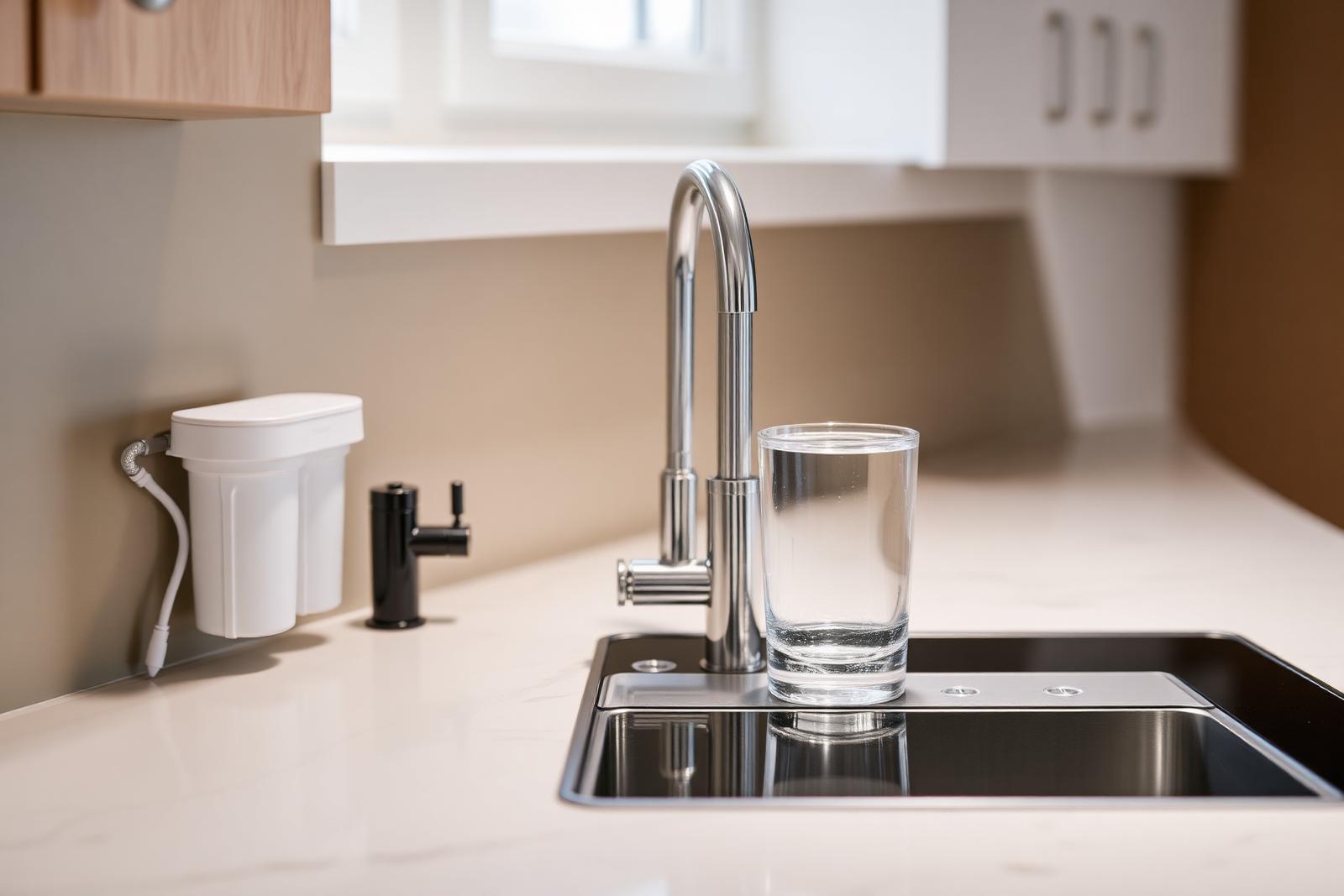
You have two main installation options for filtration. Faucet-mounted filters are the simplest—they attach directly to your existing tap. They're easy to install and a good entry-level choice. However, they can slow down water flow and may not fit all faucet designs. Under-sink filters are a more permanent and aesthetically pleasing solution. They are installed under the kitchen cabinet and connect directly to the cold water line. They often come with a small, dedicated stylish tap, meaning your main faucet is unaffected. This is the solution we most commonly install at Mudelar for a seamless, high-performance result.
Deep Dive: Reverse Osmosis (RO) Systems
For those seeking the highest level of water purity, a reverse osmosis system is the gold standard. This technology goes far beyond simple filtration. It forces water under pressure through a special semi-permeable membrane—a synthetic liner with microscopic pores. These pores are so small that they allow water molecules (H₂O) to pass through but block a vast array of larger molecules and dissolved solids.
An RO system is not just a single filter; it's a multi-stage purification process. A typical under-sink unit will have at least three, and often five or more, stages. This comprehensive approach ensures that the water is not just filtered for taste but purified of a huge range of potential contaminants, resulting in water that is exceptionally clean. This is particularly appealing for families with young children or anyone with health sensitivities.
How Reverse Osmosis Works
At the heart of the system is the RO membrane. Normal osmosis is the natural tendency of water with low solute concentration to move toward water with high solute concentration. Reverse osmosis, as the name implies, does the opposite. By applying pressure from your home's water line, it pushes water molecules from the more concentrated side (your tap water) through the membrane to the less concentrated side (the purified water). The contaminants and dissolved solids that are 'rejected' by the membrane are flushed away down the drain in what's known as 'brine' or 'reject water'.
The Multi-Stage RO Process Explained
- Stage 1: Sediment Pre-Filter: The water first passes through a sediment filter to remove rust, sand, and dirt. This protects the subsequent filters and the RO membrane.
- Stage 2 & 3: Carbon Pre-Filters: Next, it flows through one or two activated carbon filters. These remove chlorine and other chemicals that could damage the delicate RO membrane.
- Stage 4: The RO Membrane: This is the core of the system, where the actual purification happens, removing up to 99%+ of Total Dissolved Solids (TDS).
- Stage 5: Carbon Post-Filter: The purified water is stored in a small tank. When you open the dedicated tap, the water flows from the tank through a final carbon 'polishing' filter to remove any residual taste or odour before it reaches your glass.
Some advanced systems also include a sixth stage: a remineralisation filter. This adds small amounts of healthy minerals like calcium and magnesium back into the water to improve its taste and pH balance.
What Does Reverse Osmosis Remove?
The list of what a quality RO system removes is extensive. It's highly effective against:
- Total Dissolved Solids (TDS): This includes salts, minerals, and metals.
- Heavy Metals: Such as lead, mercury, arsenic, and cadmium.
- Nitrates and Nitrites: Often found in agricultural runoff.
- Fluoride: While added for dental health in some countries, many people prefer to remove it.
- Microorganisms: Including cysts like Giardia and Cryptosporidium.
Filtration vs. Reverse Osmosis: Which Is Right for Your Home?
Choosing between a standard filtration system and a reverse osmosis system is the most common decision my clients in places like Amadora and Loures face. There's no single 'best' answer; it depends entirely on your priorities. A simple carbon filter system is excellent for making good water taste great. It targets the most common aesthetic complaints—chlorine taste and odour—while leaving in the naturally occurring minerals.
On the other hand, if your primary concern is removing the widest possible range of contaminants for ultimate peace of mind, then a reverse osmosis system is the more comprehensive choice. It provides a level of purity that filtration alone cannot match. However, this comes with greater installation complexity, the production of wastewater (the reject water flushed down the drain), and the removal of minerals, which some people prefer to keep. The choice often comes down to a balance between desired purity, installation practicalities, and maintenance.
The Installation Process: What to Expect
The installation of kitchen water purifiers varies significantly with the type of system. A simple faucet-mounted filter can be done by anyone in minutes. However, for the under-sink systems that offer the best performance and aesthetics, a professional installation is strongly recommended.
For a typical under-sink carbon filter or a full reverse osmosis system, the process I follow is methodical. First, I shut off the cold water supply under the sink. Then, I install a 'T-valve' on the cold water line to divert water to the purification unit. For an RO system, a small hole must be drilled into the sink or countertop for the new, dedicated purified water tap. Brands like Silestone or Compac quartz worktops require specialised diamond drill bits to do this cleanly.
Finally, an RO system also requires a connection to the sink's drain pipe to dispose of the reject water. This involves fitting a small 'drain saddle' to the pipe. Once all connections are made, I'll turn the water back on, check meticulously for any leaks, flush the system as per the manufacturer's instructions (this is crucial for new filters), and test the water output. A professional installation typically takes between one to three hours and ensures everything is secure, leak-free, and operating at peak efficiency.
Maintenance and Long-Term Care for Your System
Request a free, no-commitment quote. We reply within 24 hours.
Request a quote →Installing a water purification system is not a 'fit and forget' solution. Proper, timely maintenance is essential to ensure it continues to provide high-quality water and operates safely. Neglecting maintenance means you could eventually be drinking water of a lower quality than the unfiltered tap water you started with.
The most frequent task is changing the filter cartridges. For most standard carbon and sediment filters, this should be done every 6 to 12 months, depending on your water usage and local water quality. For a reverse osmosis system, the pre-filters and post-filter will also need changing on a similar schedule. The RO membrane itself is far more durable and typically needs replacing only every 2 to 4 years.
We at Mudelar always provide our clients with a clear maintenance schedule upon installation. It is also important to sanitise the system periodically (usually annually) to prevent any potential bacteria growth within the filter housings or storage tank. Keeping track of these dates is key to enjoying the benefits of your investment for years to come.
Recommended materials and options
Here are some of the most common system types we install. The best choice depends on your starting water quality and purification goals.
| Type | Features | When to choose it |
|---|---|---|
| Faucet-Mounted Filter | Attaches directly to your existing faucet. Basic carbon filtration. | For renters needing a non-permanent solution or to test out water filtration. |
| Under-Sink Carbon Filter | Installed under the sink, usually with a dedicated faucet. Removes chlorine, improves taste and odour. | For homes with good quality tap water where the main goal is taste enhancement. |
| Under-Sink Multi-Stage Filter | Combines sediment and multiple carbon filters. More thorough filtration than a single filter. | If your water has some sediment or you want more comprehensive chemical reduction without RO. |
| Reverse Osmosis (RO) System | Multi-stage process including a membrane for maximum purification. Removes over 99% of TDS. | For ultimate purity, concerns about specific contaminants (heavy metals, nitrates), or very hard water. |
| RO with Remineralisation | An RO system with an additional filter that adds beneficial minerals back into the purified water. | For those who want the purity of RO but prefer the taste and pH of mineral-rich water. |
| Integrated Tap System | A complete kitchen tap (e.g., Grohe Blue) with built-in filtration, sometimes chilled and sparkling. | For a seamless, high-end kitchen design combining convenience and technology. |
Quick comparison
This table gives a clear, side-by-side look at the two main technologies to help you decide.
| Feature | Carbon Filtration | Reverse Osmosis (RO) |
|---|---|---|
| Primary Goal | Improves taste, odour, and clarity. | Maximum purity, removes dissolved solids. |
| Contaminant Removal | Good (Chlorine, VOCs, sediment). | Excellent (TDS, heavy metals, salts, nitrates). |
| Mineral Retention | Retains naturally occurring healthy minerals. | Removes most minerals (can be added back with a special filter). |
| Installation Complexity | Relatively simple, especially for non-plumbers. | More complex, requires plumbing knowledge, drain connection. |
| Water Pressure Impact | Minimal to none. | Can slightly reduce flow rate from the dedicated tap. |
| Wastewater | None. | Produces 'reject water' that is flushed down the drain. |
| Maintenance | Regular filter changes (every 6-12 months). | Multiple filter changes (6-12 months) + membrane change (2-4 years). |
Common mistakes to avoid
Over the years, I've seen a few common missteps when it comes to home water purification. Here’s what you should watch out for:
- Ignoring Your Specific Water Needs. Don't just buy the most powerful system. If your only issue is a bit of chlorine taste in Setúbal, a simple carbon filter is perfect. An RO system might be overkill.
- Forgetting About Maintenance. Filters get saturated and stop working. Even worse, they can become breeding grounds for bacteria if not changed. Set a calendar reminder on your phone the day of installation.
- Attempting a Complex DIY Installation. A poorly installed RO system can lead to persistent leaks under your sink, causing water damage to your kitchen cabinets, often made of materials like moisture-resistant MDF that can still be damaged by constant damp.
- Not Checking Your Water Pressure. RO systems require a minimum water pressure (usually around 40-50 PSI) to work effectively. If your pressure is too low, you'll get very slow water production and excessive wastewater.
- Overlooking Under-Sink Space. Some RO systems, with their filters and storage tank, take up a surprising amount of cabinet space. Measure before you choose a system to ensure it fits alongside your waste disposal and other items.
- Assuming All Filters are Equal. Look for filters certified by reputable bodies like the NSF (National Sanitation Foundation). This ensures the filter performs as advertised and is made from safe materials.
- Not Planning for the Dedicated Faucet. If you're installing an under-sink system, decide where the new, smaller faucet will go. It requires drilling a hole in your countertop or sink, so the placement needs to be right from the start.
Pre-project checklist
Before you move forward, run through this simple checklist. It will help streamline the decision-making process.
- [ ] Assess your primary goal: Is it better taste, or removing specific contaminants?
- [ ] Check your local water quality report online (your *câmara municipal* often provides this).
- [ ] Measure the available space under your kitchen sink (height, width, depth).
- [ ] Check your home's water pressure. You can buy a simple gauge that attaches to an outdoor tap.
- [ ] Decide if you want a separate, dedicated faucet for purified water.
- [ ] Identify the location of the cold water shut-off valve under your sink.
- [ ] Consider if there is a power outlet nearby (some RO systems with pumps require one).
- [ ] Think about your willingness to perform regular maintenance (changing filters).
- [ ] Review your kitchen's aesthetic. Do you want a visible system or one that is completely hidden?
How Mudelar handles it
At Mudelar, we believe in providing a complete, stress-free solution. When you approach us about installing kitchen water purifiers, our process doesn't start with a sales pitch. It starts with a conversation. We listen to your concerns about your water, whether you're in a new build in Aveiro or a renovated Pombaline apartment in Lisbon. We'll help you understand your options without overwhelming you with technical jargon.
Our turnkey service includes a full assessment, recommending a system that's right for your needs and property. Our skilled, in-house technicians handle the entire installation professionally, ensuring it's done correctly, looks tidy, and performs flawlessly from day one. We use only high-quality systems and components from trusted manufacturers, and we walk you through the maintenance schedule so you feel confident managing it long-term. It's all part of our commitment to quality that you can learn more about on our about us page. Check out our full range of our services and let's make your home better, together. When you're ready, simply request a free quote.
Frequently asked questions (FAQ)
How long does it take to install a kitchen water purifier?
An under-sink system, whether it's a multi-stage filter or a full reverse osmosis unit, is typically installed by a professional in 1 to 3 hours. This includes fitting the valves, mounting the unit, drilling the hole for the dedicated tap, connecting the drain line (for RO), and flushing the system.
Do I need a permit to install a water filter in Portugal?
No, you do not need a licence or permit from the local council (*câmara municipal*) to install a Point-of-Use water purification system inside your own home. It is considered a minor plumbing modification, similar to changing a tap, and does not fall under any building regulations that would require a permit.
Is a reverse osmosis system worth it in Lisbon?
This depends on your goals. Lisbon's water is safe, but some people are sensitive to the chlorine taste or have concerns about TDS and old pipes. If you want the absolute highest level of purity and peace of mind, or simply prefer the taste of purified water, then an RO system is an excellent investment in your well-being.
What's the difference between a water filter and a water softener?
A water filter removes contaminants like chlorine, sediment, and chemicals to improve taste and quality. A water softener, on the other hand, specifically targets minerals like calcium and magnesium that cause 'hard water'. It uses an ion exchange process and does not filter out other contaminants. They solve two different problems.
How do I choose the right water purifier for my family?
Consider three things: 1) What do you want to remove? (Chlorine taste vs. a wider range of contaminants). 2) How much space do you have under your sink? 3) What is your capacity for maintenance? Answering these questions will guide you to either a simpler filtration system or a more comprehensive RO system.
Will a water purifier reduce my water pressure?
A standard under-sink filter will have a negligible effect on your main faucet's pressure, as it only treats water going to a separate, smaller tap. A reverse osmosis system will have a slower flow rate from its dedicated tap compared to your main faucet. This is normal, as the water is produced and stored in a tank.
How often do I need to change the filters?
For most under-sink systems, the sediment and carbon pre-filters should be changed every 6 to 12 months. The final polishing filter is usually changed annually. The core RO membrane is the most durable component and typically lasts 2 to 4 years. We always provide a clear schedule at Mudelar.
Does reverse osmosis remove healthy minerals from water?
Yes, the RO process is so fine that it removes most dissolved minerals, including calcium and magnesium. While we get most of our minerals from food, some people prefer mineral water. For this reason, many RO systems now offer an optional 'remineralisation' filter that adds these healthy minerals back into the water before it reaches your glass.
Is the tap water in Porto safe to drink without a filter?
Absolutely. The municipal water in Porto, managed by Águas do Porto, is of very high quality and is perfectly safe to drink directly from the tap according to all national and EU standards. A water filter is a personal choice for those who wish to improve the taste by removing residual chlorine or for added peace of mind.
Conclusion
Choosing the right kitchen water purifier for your home in Portugal is a personal decision that enhances your daily quality of life. Whether you opt for a straightforward carbon filter to improve the taste of your morning coffee or a reverse osmosis system for the ultimate purity, you are taking a proactive step towards better water. Understanding the distinction between these technologies is key. Filtration targets aesthetics like taste and odour, while reverse osmosis provides comprehensive purification. I hope this detailed guide has clarified your options and given you the confidence to move forward. If you have any further questions or would like a professional assessment for your home, our team at Mudelar is always ready to help. Please don't hesitate to request a free quote and start your journey to better water today.
Ready to start your renovation?
Request a free, no-commitment quote. We reply within 24 hours.
Request a quoteLer em português: Purificadores de Água na Cozinha 2026: Filtros ou Osmose? | Mudelar