
06 August 2026
Kitchens 2026: Melamine vs Lacquered vs Veneered | Mudelar
Confused about melamine vs lacquered vs veneered kitchens? Our expert guide explains durability, finishes, and care for your Portugal home. Get a free quote.
As a technical lead at Mudelar, I’ve guided hundreds of clients through the pivotal choices that define a kitchen renovation. One of the most common, and crucial, decisions is the finish of the cabinet doors. This choice impacts not just the aesthetics but also the durability, maintenance, and long-term satisfaction with your space. Understanding the differences between melamine vs lacquered vs veneered kitchens is fundamental. In this detailed guide, I will break down the characteristics of each material, drawing on my hands-on experience in homes across Porto and northern Portugal. You will learn precisely what each finish is, its pros and cons, and which is best suited for your lifestyle and home.
Quick summary
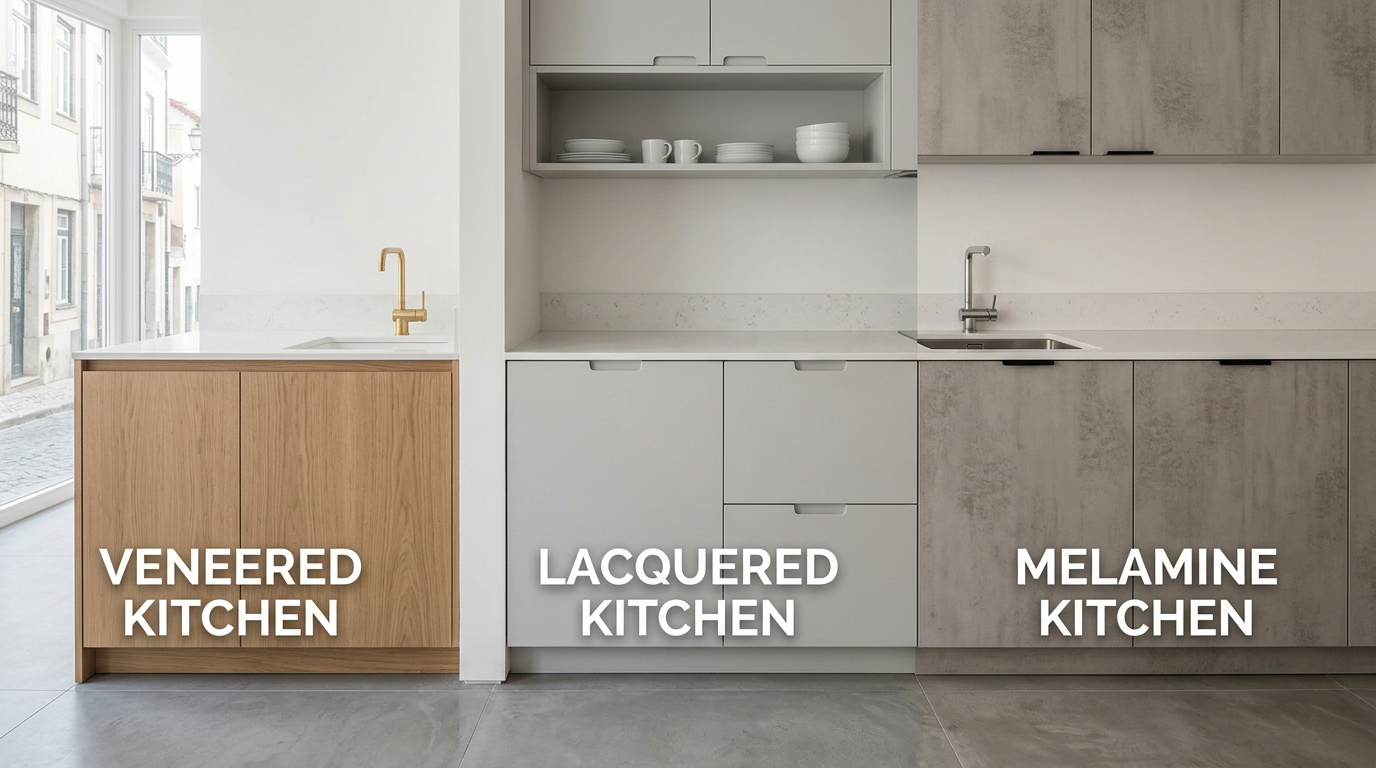
- Melamine is a highly durable and practical finish, created by fusing a resin-impregnated paper onto a substrate, offering excellent resistance to scratches and stains in a vast range of colours and patterns.
- Lacquered finishes provide a premium, seamless look with unlimited colour possibilities, available in finishes from high-gloss to super-matte, perfect for modern and minimalist designs.
- Veneered cabinets offer the natural warmth and unique beauty of real wood, as they are covered with a thin slice of timber, making every kitchen door one-of-a-kind.
- The base material is critical, with moisture-resistant MDF (often called MDF hidrófugo) being the superior choice for the humid Portuguese climate, especially in coastal areas like Aveiro or Setúbal.
- Your lifestyle dictates the best choice: melamine is ideal for busy families, lacquer for design-focused individuals, and veneer for those seeking natural elegance.
- Maintenance varies significantly; melamine is the easiest to clean, while veneer requires more delicate care to protect the natural wood surface.
Table of contents
- Understanding Kitchen Cabinet Finishes
- Melamine Kitchens: The Practical Powerhouse
- Lacquered Kitchens: The Seamless & Sophisticated Finish
- Veneered Kitchens: The Authentic Beauty of Wood
- Melamine vs Lacquered vs Veneered: A Direct Comparison
- Technical Aspects for Kitchens in Portugal
- Choosing the Right Finish for Your Lifestyle
Understanding Kitchen Cabinet Finishes
Before we compare the finishes, it’s essential to understand the core material they are applied to. In most modern kitchens, cabinet doors and carcasses are not made of solid wood. Instead, they are built from engineered wood panels, primarily particleboard or Medium-Density Fibreboard (MDF). Particleboard is made from wood chips and particles bonded with resin, while MDF is created from finer wood fibres, resulting in a denser, smoother, and more stable panel.
For kitchen environments in Portugal, I almost always recommend an MDF hidrófugo (moisture-resistant MDF) substrate. This engineered panel is specifically treated to perform better in humid conditions, which is a non-negotiable feature for kitchens, especially in coastal cities from Porto to the Algarve. The finish—whether melamine, lacquer, or veneer—is the decorative and protective layer applied over this core panel. Its quality, combined with the quality of the substrate, determines the cabinet's final look, feel, and lifespan.
Particleboard vs. MDF
Particleboard is generally a more economical option. It's lighter than MDF, which can be an advantage for installation. However, it has lower structural integrity and is more susceptible to swelling and damage from moisture if the surface layer is compromised. Its rougher surface is not ideal for high-quality painted or lacquered finishes.
MDF provides a superior foundation. Its smooth, uniform surface is perfect for applying lacquer or thin veneers without any imperfections showing through. It holds screws better than particleboard and its density provides a more solid, premium feel to the doors. For the minimal difference in material investment, the long-term benefits of MDF—especially the moisture-resistant variety—far outweigh the initial savings of particleboard for a quality kitchen renovation.
Melamine Kitchens: The Practical Powerhouse
Melamine is perhaps the most common and practical finish for modern kitchen cabinets. It’s not a liquid coating but a solid, pre-finished material. A sheet of paper, saturated with melamine resin, is thermally fused to an MDF or particleboard substrate under high pressure and heat. This process, known as thermofusion, creates a hard, durable, and non-porous surface that is integrated with the board itself.
One of the greatest strengths of melamine is its consistency and variety. Because the decorative layer is essentially a printed paper, it can replicate anything from solid colours and abstract patterns to highly convincing wood grains or even stone textures. Reputable brands like Egger and Kronospan offer extensive catalogues with synchronised textures, where the embossed finish matches the printed grain, adding a surprising level of realism. This makes melamine an incredibly versatile choice for achieving a desired look without the maintenance or vulnerabilities of the natural material it mimics.
Durability and Maintenance
When it comes to the demands of a busy kitchen, melamine excels. The thermoset resin surface is highly resistant to scratches, abrasion, stains, and heat. Spills from coffee, wine, or oils can be wiped away easily with a damp cloth and mild detergent, leaving no trace. This makes it an ideal choice for families with young children or for rental properties where durability is paramount.
The main vulnerability of a melamine door is its edges. High-quality melamine cabinets use robust ABS or PVC edge banding, applied with strong PUR (polyurethane) glue to seal the edges completely against moisture ingress. Poorly applied or thin edge banding can chip or peel over time, exposing the substrate underneath. This is an area where quality manufacturing makes a significant difference.
Design Possibilities
Years ago, melamine was seen as a basic, uninspired option. Today, that couldn't be further from the truth. Modern melamine panels come in an astonishing array of finishes. You can opt for a super-matte, soft-touch surface that resists fingerprints, a high-gloss finish that brightens a room, or a deeply textured wood grain that adds warmth and character. The consistency of the finish means that every door and panel will match perfectly, which is a key advantage for a cohesive, uniform look in a minimalist kitchen design in a Lisbon or Porto apartment.
Lacquered Kitchens: The Seamless & Sophisticated Finish
For those seeking a completely seamless, custom-coloured, and premium finish, lacquer is the undisputed champion. Unlike melamine, lacquer is a liquid coating—essentially a type of high-quality paint—that is sprayed onto a perfectly prepared MDF panel. The process involves applying multiple layers, often including a primer, several colour coats, and a final protective clear coat, with sanding between each application. This meticulous process results in a flawless, continuous finish that wraps around the edges and profiles of the door.
The biggest draw of lacquered kitchens is the infinite colour customisation. You can match your cabinets to any colour swatch from any paint brand, allowing for perfect coordination with your walls, tiles, or other design elements. This level of personalisation is simply not possible with pre-finished materials like melamine or veneer. The finish can also be specified, from a brilliant high-gloss that reflects light and creates a sense of space, to a sophisticated satin or a contemporary super-matte.
The Lacquering Process
The quality of a lacquered finish is directly proportional to the quality of the process. At Mudelar, we work with specialised workshops where this is an art form. It begins with a high-density, moisture-resistant MDF panel, which is cut and machined to the desired shape. The panel is then meticulously sanded to an ultra-smooth surface. A primer is applied to seal the MDF and create a perfect base. Multiple thin coats of polyurethane or polyester lacquer are then sprayed on in a dust-free environment. For a high-gloss finish, the final coat is painstakingly polished and buffed to achieve a mirror-like sheen. This is a labour-intensive process that cannot be rushed.
High-Gloss vs. Matte Lacquer
Choosing between a high-gloss or matte lacquered finish is a key aesthetic decision. High-gloss lacquer is excellent for smaller or darker kitchens, as its reflective surface bounces light around the room, making it feel larger and brighter. It creates a sleek, modern, and luxurious look. However, it does show fingerprints, smudges, and minor scratches more readily, requiring more frequent cleaning.
Matte and super-matte lacquers, on the other hand, offer a softer, more contemporary and understated elegance. They absorb light, creating a calm and uniform block of colour. High-quality matte finishes now often include anti-fingerprint technology, making them surprisingly practical. Matte is less likely to show minor imperfections and can feel warmer and more inviting than its high-gloss counterpart.
Veneered Kitchens: The Authentic Beauty of Wood
Veneered kitchens strike a beautiful balance between the natural world and modern engineering. A veneer is a very thin slice of real wood (typically 0.6 mm to 1 mm thick) that is glued onto a stable substrate, almost always MDF. This gives you the authentic grain, texture, and warmth of solid wood without the associated problems of warping, splitting, or high cost.
Because it is real wood, every veneered door is unique. The natural variations in grain patterns and colour tones mean no two kitchens will be exactly alike. This provides a level of character and authenticity that printed reproductions, no matter how good, cannot fully replicate. It’s the perfect choice for homeowners in places like Sintra or the Douro valley who want to bring a touch of nature and timeless elegance into their homes.
Types of Wood Veneer
There is a vast range of wood species available as veneers, from traditional choices like Oak, Walnut, and Ash to more exotic options. The way the wood is sliced from the log also affects the final grain pattern (e.g., crown cut, quarter cut). Furthermore, you can choose between natural veneers, which showcase the wood's original colour and pattern, and reconstituted (or 'engineered') veneers. Reconstituted veneers are made from real, fast-growing wood that is dyed, laminated, and re-sliced to create a consistent, predictable grain pattern, ideal for projects requiring a uniform look across many panels.
Upkeep and Longevity
As a natural material, wood veneer requires a bit more care than melamine. It is typically finished with a clear acrylic or polyurethane lacquer to protect it, but it remains more susceptible to scratches and impacts than a hard melamine surface. It's also sensitive to prolonged exposure to direct sunlight, which can cause the colour to fade or change over time. Using UV-protective lacquers can mitigate this significantly.
Moisture is the primary enemy. While the protective lacquer helps, any deep scratch that exposes the wood can allow moisture to penetrate, potentially causing the veneer to lift or bubble. This is why a high-quality substrate and flawless application are critical. Cleaning should be done with a soft, damp cloth, avoiding harsh chemicals or abrasive cleaners.
Melamine vs Lacquered vs Veneered: A Direct Comparison
To make the decision clearer, let's directly compare the three finishes across the most important factors for a kitchen renovation in Portugal.
- Aesthetics & Customisation: Lacquer is the winner for customisation, offering limitless colours and finishes from matte to high-gloss. Veneer is unmatched for natural, unique wood beauty. Melamine offers the widest variety of consistent patterns, including realistic wood and stone effects.
- Durability & Resistance: Melamine is the most durable and resistant to scratches, stains, and daily wear and tear. It's the workhorse of the three. Lacquered finishes are more prone to scratching and chipping, especially on edges, and repairs can be difficult to blend seamlessly. Veneer is softer than melamine and can be scratched or dented, though minor damage can sometimes be repaired by a specialist.
- Maintenance: Melamine is the easiest to clean; a simple wipe-down is usually sufficient. High-gloss lacquer requires more frequent cleaning to remove fingerprints. Matte lacquer with anti-fingerprint properties is much lower maintenance. Veneer requires gentle cleaning with wood-safe products and care to avoid excess moisture.
- Water & Humidity Resistance: When applied to a moisture-resistant MDF substrate with high-quality edge sealing, all three can perform well. However, melamine's non-porous surface and robust edge banding provide the most reliable seal against everyday humidity. A deep scratch on a lacquered or veneered door creates a potential entry point for moisture that can cause more significant damage over time.
Technical Aspects for Kitchens in Portugal
Living in Portugal presents specific environmental factors we must consider during a renovation. The proximity to the Atlantic means that humidity levels in coastal cities like Porto, Aveiro, and the greater Lisbon area (including Oeiras and Cascais) are consistently high, especially during winter.
This is why I cannot overstate the importance of using MDF Hidrófugo (moisture-resistant MDF) as the standard substrate for all kitchen and bathroom cabinetry. This material is manufactured with special resins that slow the absorption of moisture, preventing the swelling and delamination that can ruin standard panels. It is the professional standard for wet areas. Furthermore, proper ventilation in the kitchen is key to managing ambient humidity and protecting your investment, a factor we always assess as part of our turnkey renovation projects.
Energy efficiency regulations like DL 118/2013 focus on the building envelope, but a holistic approach to renovation includes ensuring the internal environment is healthy and stable. A well-ventilated kitchen with durable, moisture-resistant materials contributes to a healthier home and the longevity of all its components.
Choosing the Right Finish for Your Lifestyle
Ultimately, there is no single 'best' finish; the right choice is the one that best fits your daily life, design vision, and maintenance tolerance.
- For a busy family with young children in Braga or Almada: Melamine is almost always my top recommendation. Its supreme durability and easy-clean nature provide peace of mind. The vast range of modern, stylish finishes means you don't have to compromise on aesthetics.
- For the design-conscious homeowner creating a sleek, minimalist apartment in Lisbon: Lacquered cabinets are the way to go. The seamless finish and custom colour capabilities allow for a truly bespoke and high-end look that defines a modern space.
- For those wanting to add natural warmth and timeless character to a villa in Cascais or a traditional house in Porto: Wood veneer is the perfect choice. It offers the unparalleled beauty of real wood, adding a layer of sophistication and organic texture to the heart of the home.
Recommended materials and options
Request a free, no-commitment quote. We reply within 24 hours.
Request a quote →| Type | Features | When to choose |
|---|---|---|
| High-Pressure Laminate (HPL) Melamine | Extremely robust, thicker decorative layer, superior impact and heat resistance. Brands like Finsa or Polyrey. | For high-traffic kitchens, countertops, or when maximum durability is the absolute priority. |
| Textured Melamine (Synchronised Pore) | The embossed texture perfectly matches the printed wood grain underneath for a highly realistic look and feel. From brands like Egger or Kronospan. | When you want the look of wood veneer with the durability and low maintenance of melamine. |
| PET Lacquered MDF | A modern alternative to spray lacquer. A PET foil is applied to MDF, giving a super-matte or high-gloss finish that is very durable and UV stable. | For a very modern, resilient finish that combines the look of lacquer with better scratch resistance. |
| High-Gloss UV Lacquered MDF | Multiple layers of lacquer are cured instantly with ultraviolet light, creating an exceptionally hard and stable gloss finish. | For a brilliant, mirror-like gloss finish with enhanced durability compared to standard polyurethane lacquer. |
| Natural Oak or Walnut Veneer | Timeless, authentic wood grain. Each door is unique. Offers a classic, warm, and premium aesthetic. | For creating a high-end, natural, and inviting kitchen atmosphere. Perfect for shaker or classic-modern styles. |
| Reconstituted Wood Veneer | Real wood veneer that is engineered to have a consistent grain and colour. Ideal for large spaces requiring uniformity. | When you want the feel of real wood but need a very consistent and predictable look across all cabinets. |
Quick comparison
| Feature | Melamine | Lacquer | Veneer |
|---|---|---|---|
| Durability | Excellent (highly resistant to scratches, stains) | Good (can scratch or chip, especially gloss) | Moderate (softer than melamine, can be dented) |
| Colour/Finish Options | Very Wide (solid colours, patterns, wood grains) | Unlimited (any custom colour is possible) | Limited to wood species (natural variations) |
| Aesthetic | Practical & Versatile (from basic to high-end realistic) | Premium, Seamless, Modern | Natural, Warm, Unique, Timeless |
| Maintenance | Very Low (easy to clean with standard cleaners) | Moderate (gloss shows fingerprints, requires care) | Moderate (requires gentle cleaning, wood care) |
| Water Resistance | Excellent (when properly edge-banded) | Good (vulnerable if surface is deeply scratched) | Good (vulnerable if surface is deeply scratched) |
| Edge Finish | Banded Edge (visible seam) | Seamless (continuous finish over edges) | Can be seamless or edge-banded |
Common mistakes to avoid
- Choosing a finish based only on photos. Physical samples are essential. The texture, sheen, and colour of melamine, lacquer, and veneer can look drastically different in your home's light compared to a showroom or a picture online. I always provide large samples for clients to see in their own space.
- Ignoring the substrate material. Opting for standard particleboard instead of moisture-resistant MDF to save a small amount is a false economy. In Portugal's climate, this is one of the most common points of failure I see in older or poorly executed kitchen renovations.
- Underestimating the importance of edge banding. On melamine cabinets, the quality of the edge banding and the adhesive used is paramount. A thin, poorly applied edge will inevitably fail, allowing moisture to damage the core.
- Opting for high-gloss lacquer in a high-traffic, chaotic family kitchen. While it looks stunning, the constant need for cleaning fingerprints and the higher risk of visible scratches can lead to frustration. A high-quality matte or textured melamine would be a more practical fit.
- Forgetting about UV exposure for veneer. If your kitchen receives a lot of direct, strong sunlight, a natural wood veneer can fade unevenly over time. It's crucial to either choose a location with less direct sun or ensure the veneer is treated with a high-quality UV-inhibiting topcoat.
- Not considering the repairability. Melamine is very difficult to repair cosmetically if it chips. A deep scratch in lacquer is also tough to fix without respraying the whole door. Veneer can sometimes be repaired by a specialist, but it's not always straightforward.
Pre-project checklist
- [ ] Assess your family's lifestyle: How much cooking do you do? Do you have kids or pets?
- [ ] Collect inspiration images from magazines and websites, noting the specific finishes you like.
- [ ] Request physical samples of your top 3 choices (e.g., a matte melamine, a gloss lacquer, an oak veneer).
- [ ] Place the samples in your kitchen. Check them in the morning, afternoon, and with artificial light at night.
- [ ] Consider the other finishes in your home. Do you want the kitchen to match or contrast with your flooring and furniture?
- [ ] Evaluate the natural and artificial lighting in your kitchen. A dark space may benefit from a lighter, more reflective finish.
- [ ] Discuss the substrate material (insist on MDF Hidrófugo) with your renovation partner.
- [ ] Ask about the quality and application method of edge banding for melamine options.
- [ ] Clarify the type of lacquer (polyurethane, polyester, UV-cured) and number of coats for lacquered options.
How Mudelar handles it
At Mudelar, we specialise in a complete turnkey renovation process that removes the stress and uncertainty from projects like a full kitchen overhaul. We don't just execute the plan; we guide you through every decision, including the crucial choice between melamine vs lacquered vs veneered kitchens. We begin with an in-depth consultation at your home in Lisbon, Porto, Setúbal, or Braga, where we listen to your needs and assess the space. We then provide large, high-quality samples from our trusted suppliers like Egger and Finsa, allowing you to make an informed choice with confidence.
Our process ensures every technical detail is handled, from specifying moisture-resistant MDF for all cabinetry to ensuring flawless installation by our skilled carpentry teams. By managing the entire project, we guarantee that the final result is not only beautiful but also built to last, perfectly suited to your lifestyle and the Portuguese climate. To explore how we can transform your kitchen, take a look at our services or learn more about us. When you're ready to start the conversation, simply request a free quote.
Frequently asked questions (FAQ)
H3 How long do melamine kitchens last?
A well-made melamine kitchen, using a high-quality moisture-resistant MDF substrate and robust ABS edge banding, can easily last 15 to 20 years or more. Its longevity is primarily determined by the quality of the core material and the edge sealing, rather than the melamine surface itself, which is extremely durable and resistant to fading and wear from normal use. Proper installation is key to its lifespan.
H3 Is lacquered MDF good for kitchens?
Yes, lacquered MDF is an excellent choice for kitchens, provided it is done to a high standard. It offers a premium, seamless, and highly customisable finish. For best performance, you should ensure it's applied over moisture-resistant MDF (hidrófugo) and that the lacquer itself is a high-quality polyurethane or polyester type, which provides good hardness and resistance. While more susceptible to scratches than melamine, it is a durable and beautiful option for modern designs.
H3 What is the difference between veneer and solid wood cabinets?
Veneered cabinets have a thin layer of real wood applied over a stable MDF core, while solid wood cabinets are made entirely from planks of wood. Veneer is more stable than solid wood; it will not warp, crack, or split due to changes in humidity and temperature, which is a significant risk with solid wood. Veneer also allows for more consistent grain patterns and is a more sustainable use of premium hardwoods.
H3 Can you repaint melamine or lacquered kitchen cabinets?
Repainting lacquered cabinets is possible, but it requires extensive professional preparation, including thorough cleaning, sanding, and priming to ensure the new paint adheres properly. It's a complex job to achieve a factory-quality finish. Repainting melamine is even more challenging due to its non-porous, plastic-like surface. Specialised primers are required, and the durability of the new finish is often inferior to the original factory surface. Generally, we advise against it for a long-lasting result.
H3 Is veneer waterproof enough for a kitchen?
Wood veneer itself is not waterproof. Its resistance to moisture comes entirely from the protective clear coats of lacquer applied over it and the moisture-resistant substrate underneath. A high-quality finish will seal the veneer effectively against occasional splashes and ambient humidity. However, if the surface is deeply scratched or damaged, or if water is left to pool on a surface, it can penetrate and damage the veneer and the core material.
H3 How do I clean and maintain each type of finish?
For melamine, use a soft cloth with warm water and a mild, non-abrasive detergent. For lacquer, use a microfiber cloth to avoid scratches; for high-gloss, a damp cloth followed by a dry one prevents water spots. Avoid harsh chemicals. For veneer, use a soft, slightly damp cloth, wiping in the direction of the wood grain. Never use abrasive cleaners or allow water to sit on the surface. A wood-safe cleaner can be used occasionally.
H3 Which finish is most resistant to scratches and impacts?
Without a doubt, melamine is the most resistant to scratches, abrasion, and impacts in a typical kitchen environment. The thermofused resin surface is exceptionally hard. High-Pressure Laminate (HPL) is an even tougher variant of this. Lacquered finishes, especially high-gloss ones, are the most susceptible to fine scratches and chipping. Veneer falls in the middle; it is softer than melamine and can be dented or scratched under force.
H3 Does a lacquered finish yellow over time?
Lower-quality, oil-based lacquers can yellow over time, especially when exposed to direct sunlight. However, modern, high-quality kitchens use two-part polyurethane or acrylic lacquers that are UV-stable and highly resistant to yellowing. When choosing a lacquered kitchen, especially in a light colour or white, it is crucial to confirm with your provider that they use a non-yellowing, UV-resistant lacquer formulation.
Conclusion
Choosing between melamine vs lacquered vs veneered kitchens is a decision that balances aesthetics, practicality, and personal lifestyle. Melamine offers unmatched durability for busy households, lacquer provides limitless customisation for a high-end, modern look, and veneer delivers the unique, natural warmth of real wood. As we've seen, the underlying quality of the substrate and the skill of the fabrication are just as important as the finish itself. I hope this guide has armed you with the knowledge to make a confident choice for your home renovation in Portugal. For personalised advice and to see these materials firsthand, I invite you to request a free quote with our team at Mudelar.
Ready to start your renovation?
Request a free, no-commitment quote. We reply within 24 hours.
Request a quoteLer em português: Cozinhas: Melamina, Lacado ou Folheado em 2026? | Mudelar