
29 July 2026
Pre-Renovation Checklist 2026: Your Essential Guide | Mudelar
Your essential pre-renovation checklist for a smooth project in Portugal. This homeowner's guide covers planning, permits, and materials. Get a free quote today!
As the technical lead at Mudelar, I’ve overseen countless renovations across Porto, Lisbon, and beyond. I can tell you with certainty that the success of any project is determined long before the first hammer swings. A thorough pre-renovation checklist is not just a document; it’s your roadmap to a stress-free transformation. It turns an overwhelming process into a series of manageable steps. Whether you're planning a full apartment refurbishment in Lisbon or a kitchen update in the Algarve, this guide will walk you through defining your goals, navigating Portuguese regulations, and assembling the right team. My goal is to equip you with the knowledge to start your renovation journey with confidence.
Quick summary
- Define your purpose: Clearly establish *why* you are renovating—whether for lifestyle improvement, increased property value, or necessary repairs.
- Plan your finances: Understand your financial capacity and set aside a contingency fund, but remember to get professional quotes for an accurate scope.
- Assemble the right team: Decide between DIY, hiring individual tradespeople, or engaging a turnkey company for a fully managed process.
- Navigate Portuguese permits: Research whether your project requires a *Comunicação Prévia* or a full *Licenciamento de Obras* from your local council (*Câmara Municipal*).
- Select materials wisely: Finalise your design, layout, and all material selections—from tiles to taps—before work begins to prevent delays.
- Prepare your home: Plan for the practicalities, including clearing the renovation zone, protecting belongings, and arranging alternative accommodation if needed.
Table of contents
- Define Your Renovation Goals
- Financial Framework: Planning for Success
- Assembling Your Professional Team
- Navigating Permits and Licences in Portugal
- Design and Material Selection
- Practical Preparations for Your Home
- Recommended materials and options
- Quick comparison
- Common mistakes to avoid
- Pre-project checklist
- How Mudelar handles it
- Frequently asked questions (FAQ)
- Conclusion
Define Your Renovation Goals
<a id="define-your-renovation-goals"></a> Before you look at a single tile or paint swatch, you must ask yourself the most important question: *why* are you renovating? The answer will shape every subsequent decision. Is your family growing, requiring an extra bedroom or a more functional kitchen? Are you updating an older property in Porto to improve your quality of life? Or are you aiming to increase the rental or sale value of an investment property in a high-demand area like Cascais or Sintra? Your motivation is the foundation of your project's scope.
Once you know your 'why', you can define your objectives. These should be specific and measurable. Instead of a vague goal like "improve the bathroom," a better objective is "reconfigure the bathroom layout for a walk-in shower, add a double vanity, and replace all fixtures with water-efficient models." This level of detail helps create a clear project brief for your designer or contractor. I always advise clients to create a 'must-have' list and a 'nice-to-have' list. This helps with prioritisation and scope management later on.
Prioritising Needs vs. Wants
Creating two distinct lists—one for essential requirements and another for desirable features—is a crucial step. The 'must-have' list includes non-negotiable items, such as fixing a leaky roof, updating dangerous wiring, or creating a more accessible bathroom for an elderly relative. These are the core reasons for your renovation. The 'nice-to-have' list might include features like underfloor heating, a specific brand of appliance like Grohe or Roca, or premium engineered quartz countertops from a brand like Silestone.
This separation is invaluable when you begin discussing the project with professionals. It allows us to understand your priorities and structure a proposal that addresses the critical needs first. If the initial scope doesn't align with your financial framework, we can then have a productive conversation about which 'nice-to-have' items could be postponed, modified, or omitted without compromising the project's primary goals. This is a far more effective approach than making reactive cuts mid-project.
Thinking Long-Term
Consider how your needs might evolve over the next 5 to 10 years. Are you planning to start a family, or will your children be leaving home soon? Do you foresee working from home more permanently? Planning for these future scenarios can make your renovation more durable and valuable. For example, if you're renovating a ground-floor space, consider designing doorways and hallways to be wheelchair-accessible. It’s a small adjustment now that could have a significant impact later. A long-term perspective ensures your renovated home serves you well for years to come.
Financial Framework: Planning for Success
<a id="financial-framework-planning-for-success"></a> While I cannot discuss specific figures—as every project is unique—I can provide a strategic framework for your financial planning. The most common mistake homeowners make is underestimating the full scope of a renovation. A successful project requires more than just a figure for construction; it involves careful planning, securing professional quotes, and anticipating the unexpected. Avoid creating a 'budget' in isolation. Instead, focus on defining a detailed project scope first.
Your first step should be to get detailed, written quotes from at least two or three reputable companies. A professional quote isn't just a number; it's a comprehensive document that itemises labour, materials, and services. At Mudelar, our quotes are exhaustive, ensuring transparency from day one. This allows you to compare like-for-like and understand exactly what is included. Only after you have these detailed proposals can you truly understand the financial commitment required for your vision.
Every renovation project should also include a contingency fund. This is a separate amount set aside to cover unforeseen issues that can arise, especially in older Portuguese properties. Problems like hidden structural damage, outdated plumbing, or electrical systems that don't meet current code can't always be identified until demolition begins. I generally advise my clients to plan for a contingency to ensure these discoveries don’t derail the project. It provides peace of mind and financial flexibility.
Assembling Your Professional Team
<a id="assembling-your-professional-team"></a> Your choice of a professional team is the single most significant factor in your renovation's outcome. You generally have three options: managing the project yourself (DIY), hiring individual tradespeople, or partnering with a turnkey renovation company. The right choice depends on your experience, time availability, and the complexity of your project. For a simple paint job, DIY might be feasible. For a full apartment gut and remodel in Setúbal, a professional team is essential.
Hiring individual trades—a plumber, an electrician, a tiler, a painter—can sometimes seem like a direct route. However, this puts you in the role of project manager. You become responsible for coordinating schedules, resolving conflicts, ensuring quality control, and managing deliveries. My experience shows this can be incredibly stressful and time-consuming, often leading to delays and communication breakdowns if you aren’t a seasoned professional. It requires a deep understanding of construction sequencing and local practices.
A turnkey company like Mudelar offers a comprehensive, single-point-of-contact solution. From initial design and architectural plans to navigating permits with the *Câmara Municipal* in Braga and managing all construction works, we handle everything. This integrated approach ensures seamless coordination, a fixed timeline, and a clear line of accountability. It removes the burden from you, the homeowner, allowing you to focus on the exciting parts of the renovation, like choosing finishes, while we manage the complexities behind the scenes.
Navigating Permits and Licences in Portugal
<a id="navigating-permits-and-licences-in-portugal"></a> Understanding Portuguese building regulations is a critical part of any pre-renovation checklist. Many clients, especially expats, are unfamiliar with the local requirements and assume small interior changes don't need approval. This can be a costly mistake. The rules are determined by your local municipal council (*Câmara Municipal*), so requirements in Lisbon may differ slightly from those in Aveiro. Generally, renovation projects fall into two main categories.
The first and simplest is the *Comunicação Prévia* (Prior Communication). This is typically required for interior renovations that do not alter the building's structure, facade, or roof. For example, remodelling a bathroom or a kitchen within their existing walls usually falls under this category. You (or your contractor) must notify the council of the work before it begins, submitting basic plans and paying a fee. While simpler than a full licence, it's a mandatory legal step.
The second category is the *Licenciamento de Obras* (Building Licence). This is a more complex and time-consuming process required for works that involve structural changes (e.g., removing a load-bearing wall), altering the exterior look of the building (e.g., changing windows or facade colour), or extending the property's footprint. This process requires detailed architectural and engineering plans and can take several months to be approved. Attempting this without a local architect or an experienced company is not advisable.
When is a permit definitely required?
- Structural alterations: Removing or altering any load-bearing walls, columns, or slabs.
- Facade changes: Changing the size or style of windows and doors, altering exterior paint colours, or adding external insulation systems.
- Extensions: Any work that increases the total square meterage or volume of the property.
- Change of use: Converting a commercial space into a residential one, for example.
Works exempt from permits
Minor repairs and maintenance that do not alter the structure or facade are generally exempt. This includes interior painting, replacing floor finishes with similar materials, or repairing existing plumbing fixtures without changing their location. These are considered *obras de conservação*. However, if your apartment is in a protected historical building (*imóvel classificado*), even these minor works might require approval. It is always best to check with an expert first. Our team at Mudelar always verifies the specific requirements for each project as part of our service.
Design and Material Selection
<a id="design-and-material-selection"></a> With your goals and team in place, the creative part of your pre-renovation checklist begins: design and material selection. Long before work starts, you should have a clear vision of the final look and feel. I encourage clients to create mood boards using services like Pinterest or by collecting magazine cutouts. This visual language is incredibly effective for communicating your aesthetic preferences—whether it's minimalist, industrial, or classic—to your designer or project manager.
This phase goes beyond aesthetics; it's about functionality. How do you use the space? For a kitchen, consider the 'work triangle' between the sink, stove, and refrigerator. Think about storage needs, countertop workspace, and lighting. For bathrooms, consider the pros and cons of a bathtub versus a walk-in shower. We often use 3D renderings to help clients visualise the layout and flow of a room, allowing for adjustments before any physical work begins. This is the time to perfect the plan on paper, not during construction.
Finalising all material selections before the project starts is crucial to staying on track. This includes flooring (like AC5 laminate or rectified porcelain tile), wall finishes, cabinetry materials (such as moisture-resistant MDF or laminates from Egger or Kronospan), countertops (engineered quartz, granite), bathroom fixtures (Sanindusa, Roca), and even lighting. Last-minute changes or delays in material availability are primary causes of project overruns. A good turnkey company will manage procurement and ensure everything is on-site when needed.
Practical Preparations for Your Home
<a id="practical-preparations-for-your-home"></a> A renovation site is a work zone, and preparing your home accordingly is essential for a smooth process. The first step is to completely clear the areas being renovated. This means emptying cabinets, removing furniture, taking down artwork, and packing away all personal belongings. It’s a perfect opportunity to declutter. Items that are staying but are in adjacent rooms should be moved or covered securely with plastic sheeting to protect them from pervasive construction dust.
Depending on the scale of the renovation, you may need to consider temporary living arrangements. For a simple bathroom remodel, you might be able to stay in the home. However, for a full kitchen renovation or a project involving multiple rooms, living on-site can be stressful and impractical due to noise, dust, and lack of amenities. Planning for a short-term rental or a stay with family can make the experience much more pleasant for everyone. Discuss the projected timeline with your contractor to make these arrangements.
Finally, being a considerate neighbour is an important, often overlooked step. Inform your neighbours about the upcoming work, its expected duration, and the working hours (which must comply with local noise regulations). Providing them with a contact number for the site manager (at Mudelar, we always do this) can help address any concerns directly and maintain good relationships. This simple courtesy goes a long way in preventing disputes and ensuring a cooperative atmosphere throughout the project.
Recommended materials and options
Request a free, no-commitment quote. We reply within 24 hours.
Request a quote →<a id="recommended-materials-and-options"></a> Choosing the right materials is a balance of aesthetics, durability, and function. Here are some common options we work with at Mudelar. For exact recommendations tailored to your project, it's best to request a free quote.
| Type | Features | When to choose |
|---|---|---|
| Flooring | Rectified Porcelain Tile: Very durable, water-resistant, minimal grout lines. Huge variety of styles. | High-traffic areas, kitchens, bathrooms, and for a modern, seamless look. |
| AC5 Laminate Flooring: Highly scratch and impact resistant, cost-effective, wide range of wood looks. | Living rooms, bedrooms, and hallways. Not ideal for wet areas like bathrooms. | |
| Countertops | Engineered Quartz (e.g., Silestone): Non-porous, stain/scratch resistant, consistent patterns. | Kitchens and bathrooms needing a durable, low-maintenance, and modern surface. |
| Granite: Natural stone with unique patterns, highly heat resistant. Requires periodic sealing. | Kitchens, especially for homeowners who prefer a natural, one-of-a-kind look. | |
| Cabinetry | Moisture-Resistant MDF (Hidrófugo): Stable, smooth surface for painting or lacquering. Resists humidity. | Kitchen and bathroom cabinets, especially in Portugal's coastal climates like Porto or Setúbal. |
| Laminate (e.g., Egger): Durable, easy to clean, vast array of colours and textures (wood, solid). | Modern kitchens and joinery where durability and a specific aesthetic are key. | |
| Taps & Fixtures | PVD Coated Brass (e.g., Grohe): Physical Vapour Deposition coating is extremely resistant to scratches. | For fixtures in statement colours (black, gold, bronze) that need to be highly durable. |
Quick comparison
<a id="quick-comparison"></a> Understanding the different approaches to managing a renovation is key. Here’s a comparison to help you decide.
| Approach | Pros | Cons | Best for... |
|---|---|---|---|
| DIY (Do-It-Yourself) | Full control over the project, potential for savings on labour. | Requires significant time, skill, and tools. High risk of mistakes, no warranty on labour. | Very small, single-trade projects like painting a room for experienced individuals. |
| Hiring Individual Trades | Can select specialists for each task. | You are the project manager. Requires coordination, scheduling, and conflict resolution. Risky. | Homeowners with deep construction knowledge and significant free time to manage the project. |
| Turnkey Company | Single point of contact, professional project management, fixed timeline, warranty on all work. | The structure is less flexible for on-the-fly changes once the project is defined and signed. | Most homeowners, especially for complex, multi-room renovations or full apartment remodels. |
Common mistakes to avoid
<a id="common-mistakes-to-avoid"></a> Over the years, I've seen the same preventable issues derail projects. Here is my list of common mistakes to avoid for a successful renovation:
- Not having a detailed plan. Starting work with only a vague idea is a recipe for disaster. You must have a detailed scope of work, architectural drawings (if needed), and all material selections finalised *before* work begins.
- Choosing a contractor based solely on the lowest quote. A significantly lower quote often means inferior materials, unskilled labour, or an incomplete scope. Always compare detailed, itemised proposals, not just the final number. Check for licenses, insurance, and references.
- Underestimating timelines and disruption. A proper renovation takes time. Rushing the process leads to poor quality. Be realistic about how long the work will take and how it will impact your daily life.
- Making frequent changes mid-project. Changing your mind about the layout or materials after work has started is the primary cause of delays and increased project scope. This is why thorough planning is so critical.
- Ignoring the permit process. Proceeding with work that requires a permit without obtaining one can lead to fines from the *Câmara Municipal*, orders to halt work, and even demolition orders. It also creates major problems when you eventually sell the property.
- Forgetting about the details. Things like the placement of light switches and electrical outlets, the direction doors swing, and adequate ventilation are small details that have a huge impact on the final usability of the space. A good plan considers everything.
Pre-project checklist
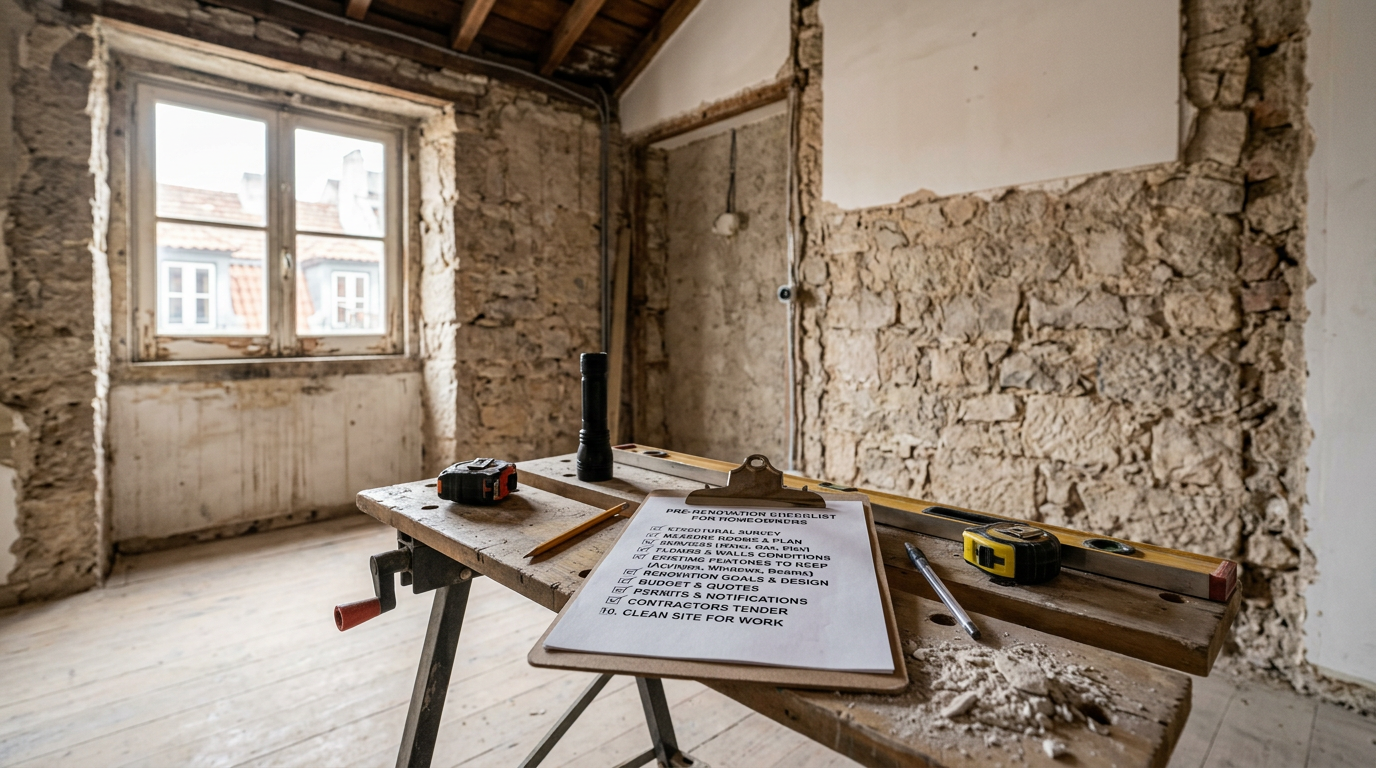
<a id="pre-project-checklist"></a> Use this actionable checklist to prepare for your renovation:
- [ ] Define Goals: Write down your primary reasons for renovating and list your 'must-have' and 'nice-to-have' features.
- [ ] Gather Inspiration: Create a mood board (digital or physical) with images of styles, colours, and materials you like.
- [ ] Research Professionals: Identify at least three potential contractors or turnkey companies. Check their portfolios, reviews, and legal registration.
- [ ] Request Detailed Quotes: Contact your shortlisted professionals to request a comprehensive, itemised quote based on your goals and inspiration.
- [ ] Verify Permits: Discuss with your chosen professional what, if any, permits (*Comunicação Prévia* or *Licenciamento*) are required for your project.
- [ ] Finalise Selections: Decide on all materials, fixtures, and finishes before signing a contract.
- [ ] Plan Logistics: Arrange for storage for your belongings and temporary accommodation if necessary.
- [ ] Notify Neighbours: Inform your neighbours of the upcoming work schedule as a courtesy.
- [ ] Review the Contract: Read the final contract carefully. Ensure it includes the full scope of work, a payment schedule, a timeline, and warranty information.
How Mudelar handles it
<a id="how-mudelar-handles-it"></a> At Mudelar, we've built our reputation on a seamless turnkey process designed to eliminate the stress and uncertainty of renovation. Your journey starts with a conversation where we listen to your needs and vision. Our team then develops a detailed proposal and 3D design, allowing you to see your new space before work begins. We handle everything from the architectural plans and permit submissions to the local councils in Lisbon or Porto to the final lick of paint. You get a dedicated project manager as your single point of contact, providing regular updates and ensuring everything runs on schedule.
Our integrated team of architects, designers, and skilled tradespeople work in perfect sync, avoiding the coordination headaches of hiring individual contractors. We believe in total transparency, which is why our contracts clearly outline the entire scope, timeline, and all selections, with a full warranty on our work. It’s a complete, end-to-end solution. To learn more about our process, explore our services or get in touch to request a free quote and start your renovation journey with a team you can trust. Learn more about us and our commitment to quality.
Frequently asked questions (FAQ)
<a id="frequently-asked-questions-faq"></a>
How long does a typical kitchen renovation take?
A complete kitchen renovation, from demolition to final finishes, typically takes between 15 and 25 working days. This timeline depends on the project's complexity, such as whether we are changing the layout, moving plumbing, or installing custom cabinetry. Finalising all material selections like countertops and tiles before work begins is the best way to ensure we adhere to this schedule and avoid delays.
Do I need a permit to renovate my bathroom in Portugal?
If you are renovating a bathroom within its existing walls and not changing the structure of the building, you will generally need to submit a *Comunicação Prévia* to your local council. This notifies them of the work. If, however, you plan to move walls or alter plumbing in a way that affects the building's main stacks, a full *Licenciamento de Obras* might be necessary. We always handle this assessment for our clients.
What is the difference between refurbishment and renovation?
Though often used interchangeably, they have different meanings. Refurbishment typically involves updating and redecorating a space—like painting, refinishing floors, and replacing fixtures. Renovation is more extensive and can involve altering the layout, moving walls, and updating systems like plumbing and electricals. Most of our projects at Mudelar involve some degree of renovation to truly transform a space.
Is it worth renovating an apartment before selling it in Lisbon or Porto?
A strategic renovation can significantly increase a property's appeal and sale value, especially in competitive markets like Lisbon and Porto. Focusing on kitchens and bathrooms usually yields the best return. A modern, clean, and functional space is more attractive to potential buyers, can lead to a quicker sale, and justifies a higher asking price. It removes objections and helps buyers visualise themselves living there.
How do I choose the right flooring for my renovation?
Choosing the right flooring depends on the room and your lifestyle. For high-traffic and wet areas like kitchens and bathrooms, rectified porcelain tile is an excellent, durable, and water-resistant choice. For living areas and bedrooms, a high-quality AC5 laminate offers great durability and the warm look of wood. We can show you samples and help you choose the best option during the design phase.
Do I have to move out during the renovation?
It depends on the project's scale. For a single-room remodel like a bathroom, it's often possible to remain in your home. However, for a full apartment renovation or a kitchen remodel where dust will be widespread and essential services will be disconnected, we strongly recommend arranging temporary accommodation. This ensures your comfort and safety and allows our team to work more efficiently.
What's more important: aesthetics or functionality?
The ideal renovation achieves a perfect balance between both. A beautiful kitchen that is impractical to cook in is a failure, as is a functional but uninspiring bathroom. Our design process at Mudelar focuses on a 'functional beauty' approach. We start by mapping out the most practical and ergonomic layout for your needs, then apply your desired aesthetic using high-quality materials and finishes.
How can I ensure my renovation is energy efficient?
This is a great question. You can improve energy efficiency by installing high-performance double-glazed windows, adding thermal insulation to walls or roofs (especially important under Portuguese regulation DL 118/2013), and choosing energy-efficient appliances. Upgrading to LED lighting throughout the home also makes a significant difference. These improvements can lead to long-term savings on your utility bills and a more comfortable home.
Conclusion
<a id="conclusion"></a> Embarking on a renovation is an exciting prospect, but careful preparation is the key to transforming your vision into reality without the common pitfalls. This pre-renovation checklist serves as your guide to a structured and successful project. By defining your goals, planning your resources, selecting the right team, and understanding the practical steps involved, you are setting yourself up for a smooth and rewarding experience. At Mudelar, we believe that a great result is born from a great plan. If you are ready to take the next step and transform your home in Porto, Lisbon, or anywhere in Portugal, I invite you to request a free quote. Let’s build something amazing together.
Ready to start your renovation?
Request a free, no-commitment quote. We reply within 24 hours.
Request a quoteLer em português: Checklist Remodelação 2026: 10 Passos Essenciais | Mudelar