
23 August 2026
Pull-Out Kitchen Tap Guide 2026: Pros & Cons | Mudelar
Considering a pull-out kitchen tap for your home in Portugal? Discover the benefits, types, and installation process for retractable spray taps. Get a free quote.
As a technical lead at Mudelar, I oversee countless turnkey renovations across Portugal, from historic apartments in Lisbon to modern villas in the Algarve. I can tell you that the humble kitchen tap has undergone a significant evolution. The pull-out kitchen tap is no longer just a trend; it's a practical, powerful tool that transforms kitchen functionality. If you're wondering whether this upgrade is right for your home, you've come to the right place. In this detailed guide, I'll walk you through everything I've learned from years of hands-on experience, covering the mechanics, materials, installation considerations, and maintenance tips to help you make an informed decision for your kitchen renovation.
Quick summary
- Enhanced Functionality: A pull-out tap provides a flexible, extendable hose, making it easier to fill large pots, rinse the sink, and clean vegetables with precision.
- Design Versatility: Available in a vast range of styles and finishes, from classic chrome to modern matte black, to complement any kitchen aesthetic, whether in Porto or Cascais.
- Key Components: The system relies on a flexible hose, a spray head with multiple functions, and a crucial counterweight that ensures smooth retraction after use.
- Installation Matters: While a keen DIYer might attempt it, professional installation is highly recommended to prevent leaks, ensure correct counterweight placement, and protect your warranty.
- Material and Finish are Crucial: Your choice of material—like 304 stainless steel or solid brass—and finish will determine the tap's longevity, maintenance needs, and resistance to wear.
- Pull-Out vs. Pull-Down: Pull-out taps feature a hose that pulls straight out, ideal for smaller sinks or where overhead cabinet space is limited, unlike their pull-down counterparts.
Table of contents
- What Exactly is a Pull-Out Kitchen Tap?
- The Anatomy of a Modern Pull-Out Tap
- Types of Spray Heads and Docking Systems
- Choosing the Right Materials and Finishes
- The Professional Installation Process
- Maintaining Your Pull-Out Tap for Longevity
- Integrating a Pull-Out Tap into Your Kitchen Renovation
What Exactly is a Pull-Out Kitchen Tap?
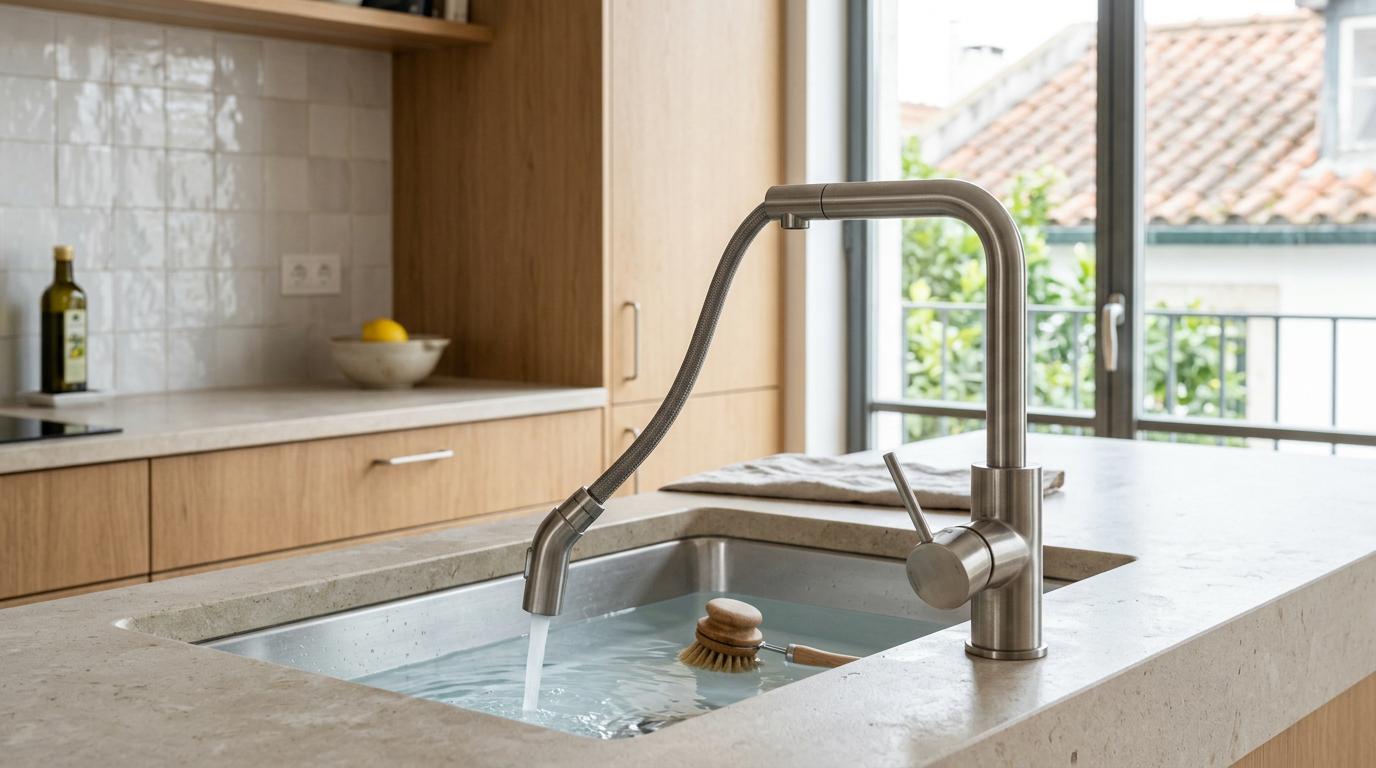
A pull-out kitchen tap is a type of mixer tap that features a detachable spray head connected to a flexible, retractable hose. Unlike a standard, fixed tap, the head can be pulled out from the main body, extending its reach significantly. This functionality is incredibly useful for a variety of daily kitchen tasks. You can easily direct the water flow to rinse the far corners of a large sink, fill a heavy pot or a coffee machine reservoir on the countertop, or gently wash delicate produce without bruising it.
The core difference between a pull-out and its close relative, the pull-down tap, lies in the direction and ergonomics. A pull-out tap typically has a more compact, wand-like spray head that you pull straight out towards you. A pull-down tap, conversely, has a taller, gooseneck spout where the head pulls directly downwards into the sink. The choice often depends on your sink size and available overhead clearance. For many kitchens we renovate in cities like Braga and Aveiro with standard-depth sinks, the pull-out style offers ample flexibility without the high arc of a pull-down model.
The Anatomy of a Modern Pull-Out Tap
Understanding the components of a pull-out tap helps in appreciating its design and identifying potential issues down the line. While they appear sleek and simple on the outside, there is some clever engineering hidden beneath your countertop. At Mudelar, we only work with reputable brands like Grohe and Roca, which use high-quality components to ensure reliability.
Key Internal Components
The heart of the system is the braided hose. Modern hoses are typically made from durable nylon or metal braid over a PEX (cross-linked polyethylene) core, designed for millions of flexes without kinking or leaking. This hose connects the spray head to the main water supply lines. The single most important, and often overlooked, component is the counterweight. This is a heavy weight clamped onto the hose under the sink. Gravity does the work here; when you release the spray head, the weight pulls the hose back down, guiding the head smoothly back into its dock.
The Spray Head and Cartridge
The spray head itself is the part you interact with daily. Quality models feature easy-to-clean silicone nozzles that resist limescale buildup—a common issue with the hard water in some Portuguese regions. A simple button or switch on the head allows you to toggle between a steady, aerated stream (for filling) and a wider, more powerful spray (for rinsing). Internally, the tap's flow and temperature are controlled by a ceramic disc cartridge. This is a huge improvement over old rubber washers, offering drip-free performance and smooth handle operation for many years. We always check that the cartridges are from a reputable manufacturer.
Types of Spray Heads and Docking Systems
The functionality of your pull-out tap is largely defined by its spray head and the mechanism that holds it in place. These features can significantly impact your day-to-day user experience, so it’s worth considering the options before making a final decision for your kitchen in Setúbal or Almada.
Stream vs. Spray Functions
Virtually all modern pull-out taps offer at least two spray patterns. The default is typically an aerated stream. The aerator infuses the water with air, creating a soft, splash-free flow that's perfect for washing hands or filling glasses. The second mode is a powerful spray, which is activated by a button on the head. This functions like a mini-pressure washer, ideal for blasting food residue off plates before they go into the dishwasher or rinsing soap from the sink basin. Some premium models even offer a third 'pause' function, which is handy for saving water while moving between tasks.
Docking Mechanisms: Magnetic vs. Friction-Fit
How the spray head returns to the tap body is another key differentiator. Traditional models use a friction-fit or gravity-based system, where the shape of the head and the pull of the counterweight are solely responsible for keeping it in place. While effective, this can loosen over time. A more modern and secure solution we often recommend is a magnetic docking system. Brands like Grohe incorporate a powerful magnet in the spout and the spray head. This ensures the head clicks back into place perfectly every time, preventing the droop that can occur with older or lower-quality taps.
Choosing the Right Materials and Finishes
The material and finish of your kitchen tap are about more than just aesthetics; they are critical for durability and ease of maintenance. A kitchen tap endures constant use, moisture, and cleaning agents. Choosing a robust material is an investment in longevity. Whether you are matching it with a Silestone countertop in Lisbon or a classic granite in Porto, the right finish ties the room together.
For the tap's core body, solid brass is a traditional gold standard, known for its durability and corrosion resistance. However, high-grade 304 stainless steel is an increasingly popular and excellent choice, especially for its naturally lead-free properties and resistance to rust and tarnishing. The finish is then applied over this base material.
Popular and Durable Finishes
Polished Chrome is a timeless classic. It's affordable, easy to match with other fixtures, and relatively durable, though it does show water spots and fingerprints. For a more modern look, Brushed Nickel or Stainless Steel finishes offer a softer, satin look that hides fingerprints better. One of the most popular trends we see in renovations across Portugal is Matte Black. When done with a high-quality application process like PVD (Physical Vapour Deposition), it is incredibly tough and resistant to scratches and fading. We also work with special finishes like brushed gold or gunmetal to create truly bespoke kitchen designs.
The Professional Installation Process
While a pull-out tap can be a DIY project, I strongly advise a professional installation. The under-sink area can be cramped, and an incorrect connection can lead to slow leaks that cause significant water damage over time. Our teams at Mudelar have installed hundreds of these taps, and our process ensures a perfect, leak-free result that protects your cabinets and flooring.
First, our plumber will shut off the main water supply to the kitchen and disconnect the old tap. The mounting area on the sink or countertop is then thoroughly cleaned. The new tap's base is fed through the hole, and from underneath, it is secured with a mounting bracket and locknut, ensuring it sits firmly without wobbling. This is a critical step; a loose tap will eventually damage the sink or countertop.
Next, the hot and cold flexible water lines are connected to the corresponding shut-off valves. We use plumber's tape to ensure a watertight seal. The pull-out hose is then connected, and the counterweight is attached at the correct position—this is vital for proper retraction. It must be positioned high enough to pull the hose back completely but low enough to allow for full extension without getting snagged on plumbing or other under-sink items. Finally, the water is turned back on, and the entire system is tested for leaks, smooth operation, and correct spray function.
Maintaining Your Pull-Out Tap for Longevity
A quality pull-out tap is built to last, but a little routine maintenance will keep it performing and looking its best for years. This is especially true in areas with hard water, which can lead to mineral buildup. Regular cleaning is the first line of defence. Wipe the tap down with a soft, damp cloth and a mild pH-neutral cleaner. Avoid abrasive sponges or harsh chemical cleaners, which can permanently damage the finish.
Most modern spray heads feature silicone nozzles (sometimes called 'SpeedClean' or 'Easy-Clean' nozzles). To clean them, you simply rub your finger over the nozzles to dislodge any mineral deposits that might be blocking the water flow. This should be done every month or so. It's also wise to periodically check under the sink. Look at the hose and connections for any signs of moisture or wear. Ensure the counterweight is still securely attached and can move freely without obstruction. With just a few minutes of care each month, a high-quality tap from a brand like Sanindusa or Roca will provide flawless service.
Integrating a Pull-Out Tap into Your Kitchen Renovation
A new tap is often part of a larger kitchen renovation project. At Mudelar, we see the kitchen as a complete system, where every element must work in harmony. A pull-out tap should not be an afterthought but an integral part of the design, chosen to complement the sink, countertops, and overall style of your home, whether it's a new build in Setúbal or a character property in Sintra.
During the planning phase, we consider the 'work triangle' and the workflow around the sink area. A pull-out tap enhances this workflow immensely. We ensure the chosen tap's scale is appropriate for the sink—a large industrial-style tap can overwhelm a small sink, while a diminutive one will look lost in a large double-basin setup. We also coordinate the finish with other metallic elements in the kitchen, such as cabinet handles and appliance trims, to create a cohesive and professionally designed look. This holistic approach is the essence of our turnkey services.
Recommended materials and options
Request a free, no-commitment quote. We reply within 24 hours.
Request a quote →| Type | Features | When to choose |
|---|---|---|
| 304 Stainless Steel | Highly durable, lead-free, naturally resistant to rust and corrosion. Often has a brushed finish. | For a modern, professional look that hides fingerprints and matches stainless steel appliances. |
| Polished Chrome | A classic, highly reflective finish. Easy to clean and widely available. | When aiming for a timeless, bright look that coordinates easily with other bathroom/kitchen hardware. |
| Matte Black (PVD) | A modern, non-reflective finish applied via Physical Vapour Deposition for extreme durability. | For creating a bold, contemporary statement. Ideal for monochrome or industrial-style kitchens. |
| Brushed Nickel (PVD) | A warm, soft-toned metallic finish that is very durable and excellent at hiding water spots. | When you want a subtler alternative to stainless steel with a slightly warmer, more inviting tone. |
| Solid Brass | The traditional base material for high-end taps, known for its heft and longevity. | For premium, classic, or vintage-style kitchens where long-term durability is the top priority. |
Quick comparison
| Feature | Pull-Out Tap | Pull-Down Tap | Standard Mixer Tap |
|---|---|---|---|
| Hose Movement | Pulls straight out towards the user. | Pulls straight down into the sink. | None. Spout is fixed. |
| Spout Profile | Generally lower profile, more compact. | High-arc, gooseneck style. | Varies, but typically fixed. |
| Headroom Clearance | Excellent. Requires minimal overhead space. | Requires significant vertical clearance above the sink. | Dependent on spout height. |
| Ideal Sink Size | Best for small to medium-sized sinks. | Best for large, deep sinks or kitchen islands. | Suitable for all sizes, but lacks flexibility. |
| Ergonomics | Hold like a wand for targeted spraying. | Pull down with a natural hand motion. | Limited to spout position. |
Common mistakes to avoid
- Ignoring Under-Sink Space. Before buying, you must check the space under your sink. A pull-out tap's hose and counterweight need clear vertical space to move freely, away from pipes or waste disposals.
- Mismatched Scale. A very large, commercial-style tap will look comical on a small bar sink, and a tiny tap will be lost on a large farmhouse sink. Ensure the tap's proportions match your sink and kitchen size.
- Incorrect Counterweight Placement. Placing the weight too low will prevent the hose from retracting fully, leaving the spray head to droop. Placing it too high will restrict the hose's reach. It must be positioned just right.
- Forgetting Water Pressure. Most modern taps are designed for standard household water pressure. However, if you live in an older building in Lisbon with very low pressure, some spray functions may not work effectively. It's worth checking compatibility.
- Choosing a Poor-Quality Finish. A cheap chrome or black finish will quickly chip, peel, or tarnish. Opting for a quality brand with a robust finish like PVD is a much better long-term investment.
- DIY Installation Without Experience. The risk of a small, slow leak from a poorly installed tap is high. This can go unnoticed for months, silently destroying your kitchen cabinets. Professional installation is always the safer bet.
Pre-project checklist
- Measure the distance from the tap hole to the backsplash to ensure the handle won't hit the wall.
- Count the number of holes in your current sink/countertop (1, 2, 3, or 4) to ensure compatibility or plan for a cover plate.
- Check the vertical clearance under the sink to confirm there is enough room for the hose and counterweight to operate.
- Assess your home's water pressure. If it's unusually low or high, discuss this with your supplier or installer.
- Decide on your preferred style: pull-out (lower profile) or pull-down (high arc).
- Choose a finish (e.g., chrome, brushed steel, matte black) that complements your kitchen's hardware and appliances.
- Confirm the tap's components (e.g., ceramic disc cartridge, braided PEX hose) are of high quality.
- Read reviews for your chosen model, specifically looking for comments on durability and ease of use.
- Plan for professional installation to ensure a leak-free and secure fit.
How Mudelar handles it
At Mudelar, integrating new fixtures like a pull-out kitchen tap is a seamless part of our turnkey renovation process. We don't just install a tap; we ensure it's the perfect choice for your kitchen's design, your family's needs, and your property's technical specifications. Our design team helps you select a high-quality model from trusted brands that complements your new countertops and cabinets. Our certified plumbers then handle the installation with precision, ensuring every connection is secure and the counterweight is perfectly calibrated for smooth, reliable operation for years to come. This attention to detail is central to our philosophy. If you want to learn more, you can read more about us and our commitment to quality.
This end-to-end management removes all the stress and uncertainty from the process. From sourcing the materials to the final polish, we handle everything, guaranteeing a result that is both beautiful and built to last. It’s the easiest way to upgrade your kitchen in Porto or the surrounding regions. To begin your renovation journey, you can easily get a free quote through our website.
Frequently asked questions (FAQ)
### How long does a pull-out kitchen tap last?
A high-quality pull-out kitchen tap from a reputable brand should last for 10-15 years, or even longer. The lifespan depends on the quality of the internal ceramic cartridge, the durability of the hose, and the local water hardness. Regular, gentle cleaning and avoiding harsh chemicals will significantly extend its life and preserve its finish. Most quality manufacturers offer a 5 or 10-year warranty on the cartridge and finish.
### Do I need a special sink for a pull-out tap?
No, you do not need a special sink. Pull-out taps are designed to be installed in a standard 35mm tap hole, which is the most common size on sinks and countertops in Portugal and across Europe. If your current sink has multiple holes (for separate hot/cold taps), you may need an escutcheon plate (a deck plate) to cover the unused holes for a clean installation.
### Is a pull-out tap worth it for a small kitchen?
Absolutely. In fact, a pull-out tap can be even more beneficial in a small kitchen. The ability to pull the spray head out to fill a pot on the counter, rather than trying to fit it into a small sink, is a major advantage. The lower profile of a pull-out model (compared to a tall pull-down) also helps to keep the space feeling open and uncluttered.
### What's the difference between a pull-out and a pull-down tap?
The main difference is ergonomics and design. A pull-down tap has a high, gooseneck spout, and the spray head pulls directly down. It's great for large, deep sinks. A pull-out tap has a lower-profile spout, and the spray head pulls out towards you. It offers more flexibility for manoeuvring around the sink area and is ideal for smaller sinks or kitchens with low overhead cabinets.
### How do I choose the right finish for my kitchen tap?
Consider both aesthetics and practicality. A Polished Chrome finish is classic and bright but shows fingerprints. Brushed finishes (like nickel or stainless steel) are better at hiding water spots. Matte Black offers a bold, modern look but should be of high quality (PVD) to resist chipping. The best approach is to match the tap finish to other hardware in your kitchen, like cabinet pulls and appliance handles, for a cohesive look.
### Do pull-out taps leak more often?
This is a common myth. A well-made pull-out tap, professionally installed, is no more likely to leak than a standard tap. Reputable manufacturers use multi-layered, high-durability hoses and robust connection points. Leaks are almost always the result of poor installation or damage to the hose from obstructions under the sink, not a flaw in the design itself.
### Do I need a plumber to install a pull-out tap?
While it is technically possible for a very confident DIYer, I always recommend hiring a licensed plumber. They will have the right tools and experience to ensure a leak-proof connection, secure the tap properly, and correctly position the counterweight. The peace of mind that comes with a professional installation is well worth it to prevent potential water damage to your kitchen cabinets.
### Can I replace a standard tap with a pull-out model?
Yes, in almost all cases. As long as you have a standard tap hole and sufficient space under the sink for the hose and counterweight, swapping a standard mixer for a pull-out tap is a very straightforward upgrade. It is one of the most common and impactful small changes we make during our kitchen renovations.
Conclusion
The pull-out kitchen tap is a fantastic marriage of form and function. It offers a level of flexibility and convenience that a standard tap simply cannot match, making daily kitchen chores quicker and easier. From rinsing vegetables to cleaning the sink, its utility is undeniable. By choosing a model made from quality materials, with a durable finish and a reliable mechanism, you are investing in a fixture that will enhance your kitchen for years. At Mudelar, we believe that the success of any renovation lies in these crucial details. Professional installation is key to unlocking the full potential and longevity of your new tap. If you're ready to improve your kitchen's functionality with a stylish and practical upgrade, I invite you to request a free quote and let us show you the possibilities.
Ready to start your renovation?
Request a free, no-commitment quote. We reply within 24 hours.
Request a quoteLer em português: Misturadoras de Cozinha Extensíveis 2026: Guia Completo | Mudelar