
08 August 2026
Soft-Close Drawers & Organisers for 2026 Kitchens | Mudelar
Discover soft-close drawers and internal organisers for a seamless kitchen. Upgrade your storage with our expert guide for homes in Portugal. Get a free quote!
Hi, I'm Marco Rodrigues, a renovation project manager here at Mudelar. With over a decade spent transforming kitchens and bathrooms across Lisbon, I've learned that true luxury isn't just about beautiful tiles or countertops. It's about how the space works for you, day in and day out. That's why I'm so passionate about soft-close drawers and internal organisers. They might seem like small details, but they are the secret to a calm, efficient, and truly functional home. In this guide, I'll walk you through everything you need to know, from the mechanics of the systems to choosing the perfect organisers for your lifestyle, ensuring your new space is a joy to use every single day.
Quick summary
- Silent & Safe Operation: Soft-close drawers use hydraulic or spring-loaded dampers to prevent slamming, making your kitchen quieter and safer, especially for families with children.
- Enhanced Durability: The gentle closing action reduces stress on drawer boxes and cabinet frames, significantly extending the lifespan of your joinery.
- Maximised Space: Internal organisers, from cutlery trays to complex corner solutions, transform chaotic cupboards into highly efficient storage, ensuring every item has a dedicated place.
- Ergonomic Benefits: Full-extension runners and well-designed organisers bring items to you, reducing the need to bend, reach, and rummage through deep cabinets.
- Material Matters: The choice of hardware (like Blum or Hettich) and drawer materials (moisture-resistant MDF, plywood) is critical for long-term performance, particularly in humid Portuguese climates.
- Customisation is Key: Bespoke solutions, tailored to your specific needs and the unique dimensions of your home in Lisbon or Porto, offer far superior results than one-size-fits-all products.
- Professional Installation Recommended: The precise alignment required for smooth operation makes professional installation a worthwhile investment for a flawless finish.
Table of contents
- What Are Soft-Close Drawers and Why Are They a Standard in Modern Homes?
- The Mechanics Behind the Magic: How Soft-Close Systems Work
- Beyond the Drawer: A Guide to Internal Organisers
- Choosing the Right Materials for Drawers and Organisers
- Step-by-Step: The Installation Process with a Professional Touch
- Custom vs. Standard Solutions: What's Best for Your Lisbon Home?
- Integrating Smart Storage in Bathrooms and Beyond
What Are Soft-Close Drawers and Why Are They a Standard in Modern Homes?
A soft-close drawer is one fitted with a special mechanism that automatically and gently slows it down in the last few centimetres of travel, pulling it shut silently. Gone are the days of startling bangs and shuddering cabinets. This feature has rapidly moved from a high-end luxury to a standard expectation in any quality kitchen or bathroom renovation, and for very good reasons. It’s a small change that has a massive impact on the daily experience of your home.
The primary benefit is, of course, the peace and quiet. No more slammed drawers echoing through the house early in the morning or late at night. This creates a more serene and pleasant environment. Secondly, there’s a significant safety aspect. The controlled closing motion prevents fingers, big or small, from getting trapped and pinched – a crucial consideration for families. Finally, it’s about longevity. The constant impact from slamming drawers puts stress on the drawer itself, the runners, and the entire cabinet structure. By eliminating this, soft-close mechanisms protect your investment and keep your joinery feeling solid and new for years to come.
Leading Hardware Brands
When we talk about soft-close systems, we're really talking about the quality of the hardware. At Mudelar, we almost exclusively work with industry-leading European brands like Blum, Hettich, and Grass. These manufacturers are pioneers in motion technology. Their products are rigorously tested for tens of thousands of cycles, ensuring they perform flawlessly for the life of your kitchen. Opting for a trusted brand guarantees a smooth, reliable glide and a closing action you can depend on, project after project.
A Mark of Quality Craftsmanship
Including soft-close hardware as standard is a clear indicator of a quality build. It shows that the cabinet maker or renovation company cares about the user experience beyond just the surface appearance. When you're inspecting a potential new kitchen or a renovated property in places like Sintra or Cascais, opening and closing a drawer is a quick test. A smooth, silent close speaks volumes about the attention to detail and the overall quality of the workmanship invested in the project.
The Mechanics Behind the Magic: How Soft-Close Systems Work
The technology behind that satisfyingly silent close is a clever piece of engineering, typically integrated into the drawer runner. While there are different designs, the core principle involves a damping system that engages as the drawer is closed. It’s not just a simple spring; it's a carefully calibrated mechanism designed for a smooth, controlled motion.
Most modern soft-close systems use a small hydraulic or pneumatic piston within a cylinder. As you push the drawer shut, a catch on the drawer engages with the mechanism. For the last 2-5 cm of travel, the piston takes over, compressing fluid or air through a small orifice. This resistance is what slows the drawer's momentum, bringing it to a gentle, silent stop. It's the same fundamental principle used in high-performance shock absorbers, scaled down for your kitchen cabinets.
Undermount vs. Side-Mount Runners
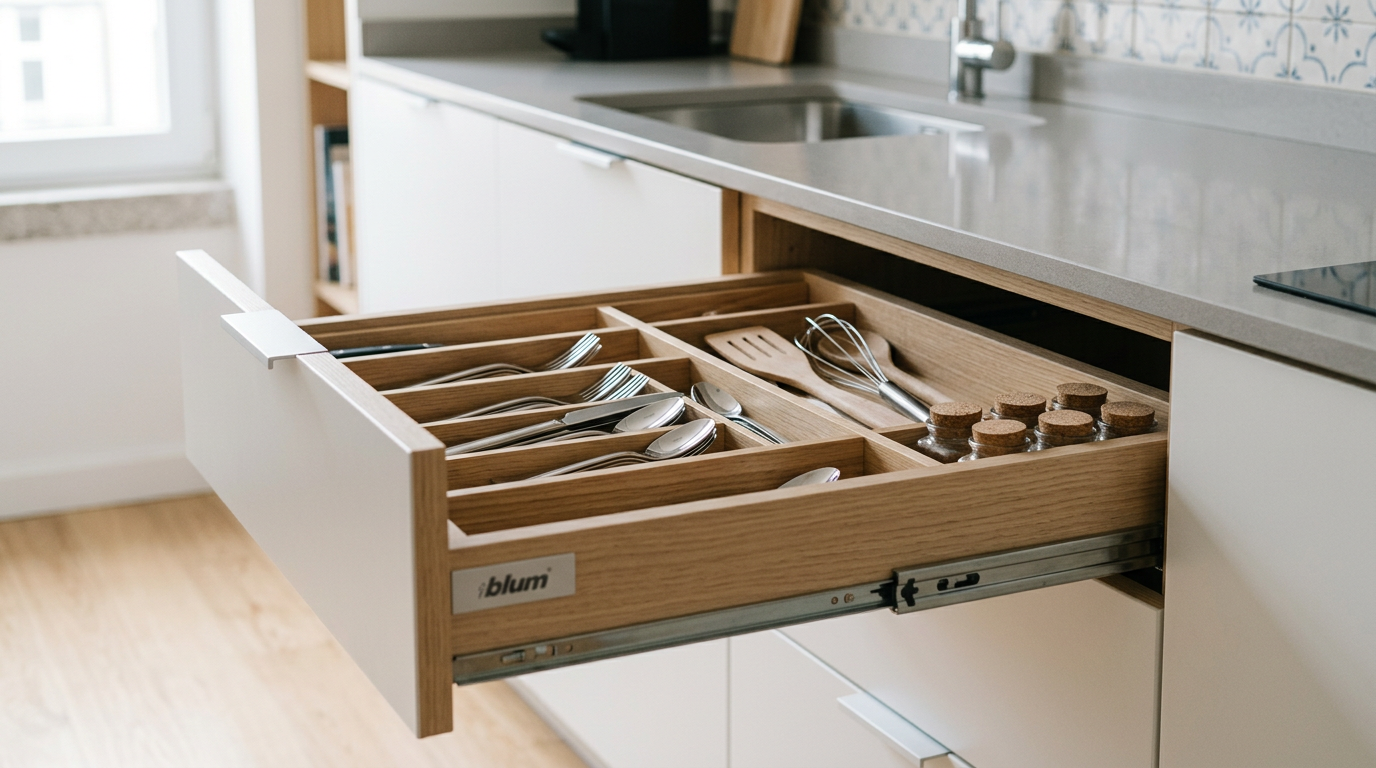
Drawer runners, the tracks the drawer slides on, come in two main types that accommodate soft-close mechanisms. Side-mount runners are the traditional style, visible on the sides of the drawer box when opened. They are robust and reliable, but the hardware is exposed. Undermount runners, however, are the premium choice. They are mounted underneath the drawer box, making them completely invisible when the drawer is open. This provides a cleaner, more high-end look and often allows for more width inside the drawer. More importantly, high-quality undermount runners like the Blum LEGRABOX or Hettich ArciTech systems offer unparalleled stability and a smoother glide, especially for wide, heavy drawers filled with pots and pans.
Key Specifications to Consider
When planning a project, we look at a few key specifications. Extension refers to how far the drawer comes out of the cabinet. Full-extension runners are essential for good ergonomics, as they allow you to see and access everything in the drawer, even items at the very back. Load capacity is another critical factor. A standard drawer runner might be rated for 25-30 kg, which is fine for cutlery. But for a deep drawer intended for stacks of plates or heavy cast-iron pans, we would specify a heavy-duty runner rated for 50 kg or even 70 kg to ensure it never sags or struggles.
Beyond the Drawer: A Guide to Internal Organisers
Once you have beautifully functioning soft-close drawers, the next step is to make the space inside them work just as hard. This is where internal organisers come in. They are the systems that transform a deep, empty box into a perfectly ordered, intuitive storage space. Effective organisation isn't about cramming more in; it's about making everything accessible, visible, and easy to put away. It’s the key to maintaining a tidy kitchen, even during the busiest of family meals.
A well-organised kitchen reduces stress and saves time. When every utensil, spice, and pan has its own designated home, you're not wasting minutes rummaging through cluttered cupboards. This is a core principle of good kitchen ergonomics. We design storage around workflows – keeping cooking oils and spices near the hob, knives and chopping boards near the prep area, and plates and cutlery near the dishwasher or dining area. This logical flow makes the kitchen a more efficient and enjoyable workspace.
Common Types of Drawer Organisers
For standard drawers, the options are vast. Cutlery inserts from brands like Orgalux can be customised with flexible dividers for utensils of all shapes and sizes. For deeper drawers, pegboard-style systems with adjustable pegs are brilliant for securing stacks of plates and bowls, stopping them from sliding around. We also frequently install knife block inserts, spice jar holders, and non-slip mats that keep everything in place.
Solutions for Tall Cabinets and Corners
Storage challenges aren't limited to drawers. Tall pantry cabinets and awkward corner cupboards are notorious for becoming black holes where items get lost. For these, we use pull-out systems. A pull-out larder unit features a series of baskets that slide out together when you open the door, presenting the entire contents of the cupboard for easy access. For blind corners, clever mechanisms like a LeMans system (with kidney-shaped shelves that swing out) or a Magic Corner (which pulls a second set of shelves out from the back) make every square centimetre of space usable.
Choosing the Right Materials for Drawers and Organisers
The materials used for your drawers and their internal fittings are just as important as the external cabinet doors. They need to be durable, resistant to wear and tear, and in many cases, resistant to moisture. A drawer box that warps or an organiser that cracks will quickly undermine the function of the most sophisticated soft-close runners. This is why we are meticulous about specifying the right materials for the job, especially for homes in coastal cities like Setúbal or Aveiro, where humidity is a year-round consideration.
The drawer box itself is the foundation. While solid wood can be used, it's susceptible to movement with changes in humidity. For this reason, we often recommend high-quality birch plywood or 16-18mm moisture-resistant MDF (often referred to as 'MDF hidrófugo'). These engineered materials are stable, strong, and provide a perfect base for attaching runners. For premium kitchens, we might use systems like Blum's LEGRABOX, which features sleek, slim metal sides combined with a solid base, offering incredible strength and a modern aesthetic.
Materials for Internal Organisers
The choice of material for the organisers themselves often comes down to a balance of function, aesthetics, and hygiene. Solid wood, particularly oak or bamboo, provides a warm, natural look and is perfect for cutlery trays and dividers. High-grade plastics (like ABS) are durable, easy to clean, and can be moulded into complex shapes for utensil holders or plate racks. For a more industrial or professional kitchen look, stainless steel dividers and inserts are hygienic, incredibly durable, and pair well with modern designs.
Finishes and Surfaces
Finally, consider the surfaces. The base of drawers should ideally be lined with a non-slip mat. This simple addition prevents items from sliding and clattering around when you open and close the drawer, protecting both the contents and the drawer base. For drawer boxes made from MDF or plywood, we ensure they are finished with a durable lacquer or laminate, like those from Egger or Kronospan, which seals the material and makes it easy to wipe clean, ensuring your storage stays fresh and hygienic for years.
Step-by-Step: The Installation Process with a Professional Touch
Achieving that perfect, gliding close requires more than just high-quality hardware; it demands precision during installation. While it might seem tempting to DIY, the tolerances are incredibly small. A millimetre out of alignment can lead to a drawer that sticks, scrapes, or doesn't close properly. As a project manager, I've seen firsthand how a professional installation makes all the difference between a frustrating experience and a flawless result.
The process begins with meticulous measurement. Before any work starts, our team measures the cabinet carcasses precisely. We check that they are square, level, and plumb. An out-of-square cabinet is the number one enemy of a smooth-running drawer. If we're working in an older building in Lisbon's historic centre, this step is absolutely critical, as walls and floors are rarely perfectly straight. We then confirm the exact model of runner and drawer box to ensure a perfect fit.
- Cabinet Preparation: Any old runners are removed, and the inside surfaces are cleaned and prepared. We check the cabinet's integrity and add reinforcement if needed, especially when fitting heavy-duty runners for pot drawers.
- Runner Installation: Using jigs and laser levels, the runners are mounted to the inside of the cabinet. This is the most crucial step. The runners must be perfectly parallel to each other and perfectly level from front to back. Even a slight angle can cause binding.
- Drawer Box Assembly & Attachment: The drawer box is assembled, ensuring it's perfectly square. Then, the corresponding clips or mounting hardware are attached to the underside or sides of the drawer box. This hardware is what will lock onto the runners inside the cabinet.
- Insertion and Adjustment: The drawer is carefully slid onto the runners until it 'clicks' into place. Now comes the fine-tuning. High-quality runners from brands like Blum have integrated 3D adjustment – allowing for tiny movements up/down, left/right, and in/out. This allows our installers to achieve perfect, consistent gaps around the entire drawer front, ensuring a seamless look across a bank of drawers.
This final adjustment phase is what separates an amateur job from a professional one. It's a task of patience and precision, but it's what guarantees your new drawers will operate beautifully for decades. This is the standard of work our teams in Braga and Porto deliver on every project.
Custom vs. Standard Solutions: What's Best for Your Lisbon Home?
When it comes to organising the inside of your cabinets, you face a choice: do you buy standard, off-the-shelf organisers, or do you invest in custom, bespoke solutions? While standard inserts can be a good starting point, my experience in the varied homes of Portugal, from modern apartments in Odivelas to historic townhouses, has shown me that custom solutions almost always deliver a superior result.
Standard organisers are designed for standard cabinet sizes (e.g., 60cm, 80cm, 90cm wide). If your kitchen is built to these dimensions, they can work well. However, you'll often be left with awkward gaps at the sides or front, which quickly become dead, wasted space where crumbs and dust collect. They offer a good-enough solution, but they rarely maximise the full potential of the drawer.
The Power of Bespoke Joinery
This is where custom solutions shine. With bespoke joinery, we are not constrained by standard sizes. We can create drawers and internal dividers that use every single millimetre of available space. This is especially valuable in older properties or uniquely shaped rooms where standard-sized cabinets simply won't fit. A custom solution means we can build a drawer that is 67cm wide if that's what the space allows, and then create an internal divider system that fits it perfectly.
Tailored to Your Life
Beyond just fitting the space, custom organisation is about fitting your life. During our design process, we don't just measure the cabinets; we inventory what you need to store. Do you have a collection of oversized serving platters? A passion for baking with lots of specific tools? A large set of chef's knives? We can design specific compartments for these items. A custom-built drawer can have a dedicated section for your stand mixer's attachments, a spice drawer with angled tiers so you can read every label, or deep dividers perfectly spaced for your pots and their lids. This level of personalisation is something a standard organiser can never achieve.
Integrating Smart Storage in Bathrooms and Beyond
Request a free, no-commitment quote. We reply within 24 hours.
Request a quote →The principles of quiet, organised, and accessible storage are not exclusive to the kitchen. Applying the same logic of soft-close drawers and internal organisers to other areas of the home, particularly the bathroom, can be equally transformative. A chaotic bathroom vanity is a common source of morning stress. By integrating smart storage, you create a calm, spa-like environment where everything has its place.
Bathroom vanity units are the perfect candidate for an upgrade. Fitting deep drawers with soft-close runners means no more slamming doors under the sink. Inside, we can install custom dividers to separate cosmetics, toiletries, and cleaning supplies. Shallow drawers with custom inserts are perfect for smaller items like makeup, toothbrushes, and contact lenses, preventing them from becoming a jumbled mess. We always use hardware and materials, such as moisture-resistant MDF, that are designed to withstand the humid environment of a bathroom.
Home Offices and Wardrobes
This thinking extends to the home office and bedroom. In a home office, soft-close drawers with dividers can neatly organise paperwork, stationery, and cables, creating a more productive and focused workspace. In a bedroom wardrobe, custom drawers can be configured for folded clothes, accessories like belts and ties, or jewellery. A well-designed wardrobe with smooth, silent drawers makes getting ready in the morning a more pleasant and efficient experience. The same Blum or Hettich systems we use in kitchens provide the same level of quality and durability in these applications.
Ultimately, smart storage is about improving your daily routines. Whether in a kitchen in Amadora, a bathroom in Loures, or a home office overlooking the sea in Cascais, the goal is the same: to create an environment that is calm, efficient, and tailored to you. It's an investment in your home's functionality and your own quality of life.
Recommended materials and options
| Type | Features | When to choose |
|---|---|---|
| Undermount Soft-Close Runner | Full extension, 30-70 kg load capacity, invisible hardware, 3D adjustment. | For a clean, high-end look in any drawer, especially heavy pot and pan drawers. |
| Pull-Out Larder Unit | Full-height frame, multiple adjustable baskets, soft-close mechanism. | To maximize storage and accessibility in tall pantry cabinets (30cm to 60cm wide). |
| Corner Cabinet Solution (LeMans) | Two independent, kidney-shaped shelves that swing out of the cabinet. | To make the contents of a blind corner cabinet fully accessible without reaching. |
| Deep Drawer Divider System | Adjustable vertical dividers or pegboard systems. | For organising pots, pans, lids, plates, or containers in deep drawers to prevent sliding. |
| Adjustable Cutlery/Utensil Insert | Made from wood, bamboo, or durable plastic with flexible dividers. | For creating custom compartments for all types of cutlery and cooking utensils. |
| Moisture-Resistant MDF | High-density fibreboard treated for humidity resistance. | For constructing durable and stable drawer boxes, especially in kitchens and bathrooms. |
Quick comparison
| Feature | Standard Runner (No Soft-Close) | Side-Mount Soft-Close | Undermount Soft-Close |
|---|---|---|---|
| Motion & Noise | Basic rolling, often noisy slam. | Smooth rolling, quiet controlled close. | Exceptionally smooth, silent, and fluid motion. |
| Drawer Longevity | Higher stress on drawer box and frame. | Reduced stress due to gentle closing. | Minimal stress, prolongs life of joinery significantly. |
| Visibility of Hardware | Visible on the sides of the drawer. | Visible on the sides of the drawer. | Completely invisible when the drawer is open. |
| Load Capacity | Typically lower (15-25 kg). | Good (25-45 kg). | Excellent, with heavy-duty options available (30-70 kg+). |
| Aesthetic | Basic, functional. | Functional, but hardware is visible. | Clean, premium, and minimalist. |
Common mistakes to avoid
- Ignoring Drawer Load Capacity. Installing standard runners for a drawer you plan to fill with heavy plates or cast-iron pots. This will lead to sagging, difficult operation, and eventual failure of the mechanism. Always match the runner's weight rating to its intended use.
- Choosing Impractical Organisers. Buying a beautiful but inflexible organiser that doesn't fit your actual utensils or containers. This leads to frustration and wasted space. Always inventory your items first and choose an adjustable or custom system.
- Attempting a DIY Installation Without the Right Tools. Trying to install undermount runners without proper jigs, clamps, and a level. This almost always results in misaligned drawers that scrape, stick, or don't close properly, defeating the purpose of the upgrade.
- Forgetting About the Corners. Focusing only on standard drawers and leaving corner cabinets as awkward, hard-to-reach spaces. Investing in a proper corner solution like a LeMans system can reclaim a huge amount of valuable storage.
- Prioritising Appearance Over Function. Choosing a drawer system based solely on its sleek look without considering how you will use it. A super-slim drawer front might look great but offer very little practical storage height inside.
- Not Planning for Drawer Depth. Using the same simple cutlery tray in a deep drawer as you would in a shallow one. This wastes a massive amount of vertical space. Deep drawers need dedicated dividers or tiered systems to be effective.
- Using Incorrect Materials in Wet Areas. Building bathroom vanity drawers from standard MDF instead of moisture-resistant MDF. The material will inevitably swell and fail in a humid environment, ruining the drawer and runners.
Pre-project checklist
- Empty your existing drawers and cabinets. Group items together to see what you have.
- Make a list of your storage 'pain points'. What's hardest to access? What's most cluttered?
- Measure the internal width, depth, and height of your main drawers and cabinets.
- Think about your daily kitchen workflow. What items do you need most frequently, and where?
- Take photos of your current drawers and their contents to discuss with a designer.
- Research different types of internal organisers online (e.g., pull-out larders, spice inserts).
- Consider what you'd store in deep drawers vs. shallow drawers.
- Think about ergonomics – what items would you love to have at waist height instead of in low cupboards?
- Decide if you want visible or concealed runners for your drawers.
- Schedule a free consultation with a professional to discuss possibilities.
How Mudelar handles it
At Mudelar, we believe that world-class storage is the backbone of any successful kitchen or bathroom renovation. Our approach is a complete, turnkey service designed to deliver a perfectly functional and beautiful result. It starts with a conversation at your home in Lisbon, Porto, or the surrounding areas. We listen to your frustrations and your wishes. We then design a comprehensive plan, often including 3D visuals, that shows you exactly how we can transform your space with soft-close drawers and internal organisers.
We source only the best hardware from trusted brands like Blum and Hettich, ensuring a lifetime of smooth operation. Our skilled joiners and installers then bring the design to life with meticulous precision, ensuring every drawer glides perfectly and every organiser fits like a glove. It's a seamless process from concept to completion, handled entirely by our dedicated team. To learn more about our philosophy, check out our services and see how we work. We handle every detail, so you don't have to. You can find out more about us on our website.
Frequently asked questions (FAQ)
How long do soft-close mechanisms last?
High-quality soft-close runners from reputable brands like Blum or Hettich are engineered for extreme durability. They are typically tested for 80,000 to 100,000 opening and closing cycles. For an average family kitchen, this translates to a lifespan of 20 years or more, often lasting for the entire life of the kitchen itself. The key is proper installation and using trusted brands, not cheap imitations.
Do I need a permit to change my kitchen cabinets and drawers?
In Portugal, for an internal kitchen renovation that doesn't alter the structure of the building, plumbing locations, or external facade, you generally do not need a municipal licence (Licença Municipal). Upgrading your cabinets and installing new drawers falls under refurbishment works. However, it's always best to confirm, and if you live in an apartment building, you should inform the condominium administration.
Is it worth upgrading to soft-close drawers?
Absolutely. From a project manager's perspective, it's one of the most impactful upgrades you can make for your daily quality of life. It makes the kitchen quieter, safer for children, and feels more luxurious. More practically, it protects your investment by reducing wear and tear on your cabinets, ensuring they last longer. It’s an upgrade with tangible benefits you'll appreciate every single day.
What's the difference between Blum and Hettich?
Both Blum (Austrian) and Hettich (German) are world leaders in furniture fittings and represent the highest standard of quality. They are competitors, and both offer exceptional products. The choice often comes down to the specific system that best suits a project's needs, installer preference, or slight differences in design aesthetics (e.g., the slimness of a drawer side). For the homeowner, either brand is an excellent choice that guarantees reliability and a smooth performance.
How do you organise deep kitchen drawers?
Deep drawers are best organised with vertical storage solutions. We use adjustable divider systems to create slots for pot lids, baking trays, and chopping boards, storing them on their sides. For plates and bowls, we use pegboard systems with adjustable pegs to keep stacks secure. This method prevents you from having to lift a heavy stack of bowls to get to the one at the bottom.
Can you add soft-close to existing drawers?
Sometimes, but it's not always straightforward or the best solution. You can buy small, add-on soft-close 'pistons' that can be retrofitted. However, these are often not as smooth or reliable as integrated systems. A better, though more involved, solution is to replace the entire runner system with a new set of soft-close runners. This depends on the construction of your existing drawer boxes and cabinets.
What are the best organisers for small kitchens?
In small kitchens, efficiency is everything. The best organisers are those that make use of vertical and awkward spaces. Pull-out larder units for tall, narrow cabinets are fantastic. For corner cabinets, a LeMans or Magic Corner system is essential to avoid wasted space. Using drawer-in-drawer systems (a shallow internal drawer inside a deep one) is also a great way to maximise utility.
How do I clean and maintain my drawer runners?
High-quality modern runners are largely maintenance-free. They are sealed units and should never be lubricated with oils like WD-40, which can damage the plastic components and attract dust. To clean them, simply wipe the runners with a dry, soft cloth to remove any dust or debris. The drawer boxes and organisers can be wiped with a damp cloth and mild detergent. That’s all the care they need.
Conclusion
Investing in high-quality soft-close drawers and internal organisers is about more than just a tidy kitchen; it's an investment in calm, efficiency, and the long-term value of your home. It transforms the daily frustration of rattling drawers and cluttered cupboards into a seamless, satisfying experience. From the silent glide of a heavy pot drawer to the simple joy of finding the right spice instantly, these systems elevate your home from simply looking good to feeling great.
If you're ready to experience the difference that truly intelligent storage can make in your Lisbon, Porto, Setúbal, or Braga home, my team and I at Mudelar are here to help. We can design and build a solution that is perfectly tailored to your space and your life. To start the conversation, please request a free quote and we'll arrange an on-site visit to explore the possibilities.
Ready to start your renovation?
Request a free, no-commitment quote. We reply within 24 hours.
Request a quoteLer em português: Gavetas com Fecho Suave: Guia Essencial para 2026 | Mudelar